Saturday, April 4, 2020

Argus C44R (1958-1962)

The C44R is an updated C44 (see the post dated November 29, 2018) with a thumb lever advance instead of a knob. The thumb lever is a little faster to use and a little easier on the fingers than the knob. It takes roughly one and a half strokes to advance the film and cock the shutter. The shutters are slightly different on the two models. The shutter speeds on the older, knob-wind version of the camera are 1/10, 1/25, 1/50, 1/100 and 1/300, while the shutter speeds on this newer, thumb lever advance camera are 1/8, 1/15, 1/30, 1/60, 1/125 and 1/300. Another change from the C44 is that you can couple a CM-2 light meter onto the shutter speed knob of the C-44R. Introduced in 1958 and discontinued in 1962, the C44R came in two versions: one with a short viewfinder housing and one with a long viewfinder housing. The advertised price was about one hundred dollars (close in buying power to a thousand of today's depreciated dollars). I do not have production numbers. The nearest equivalent camera that was made in the USA would be the Kodak Signet 80.

Front (First Version with 50 mm f/2.8 Lens)

Back (First Version)

Front (Second Version - with f/1.9 50 mm lens)

Back (Second Version)

The C44R takes the same lenses and has the same lens mount as the C44.  The stock 50mm f/2.8 lens is a Tessar type that was made by Argus in Ann Arbor, Michigan.  The lens was designed using a digital computer at the University of Michigan, and has a rare earth glass lens element.  The 35mm f/4.5, 50mm f/1.9 and 100 mm f/4.5 lenses were made by Steinheil in Munich, West Germany.
   
Additional Lenses - 35 mm f/4.5, 50 mm f/1.9 and 100 mm f/3.5.

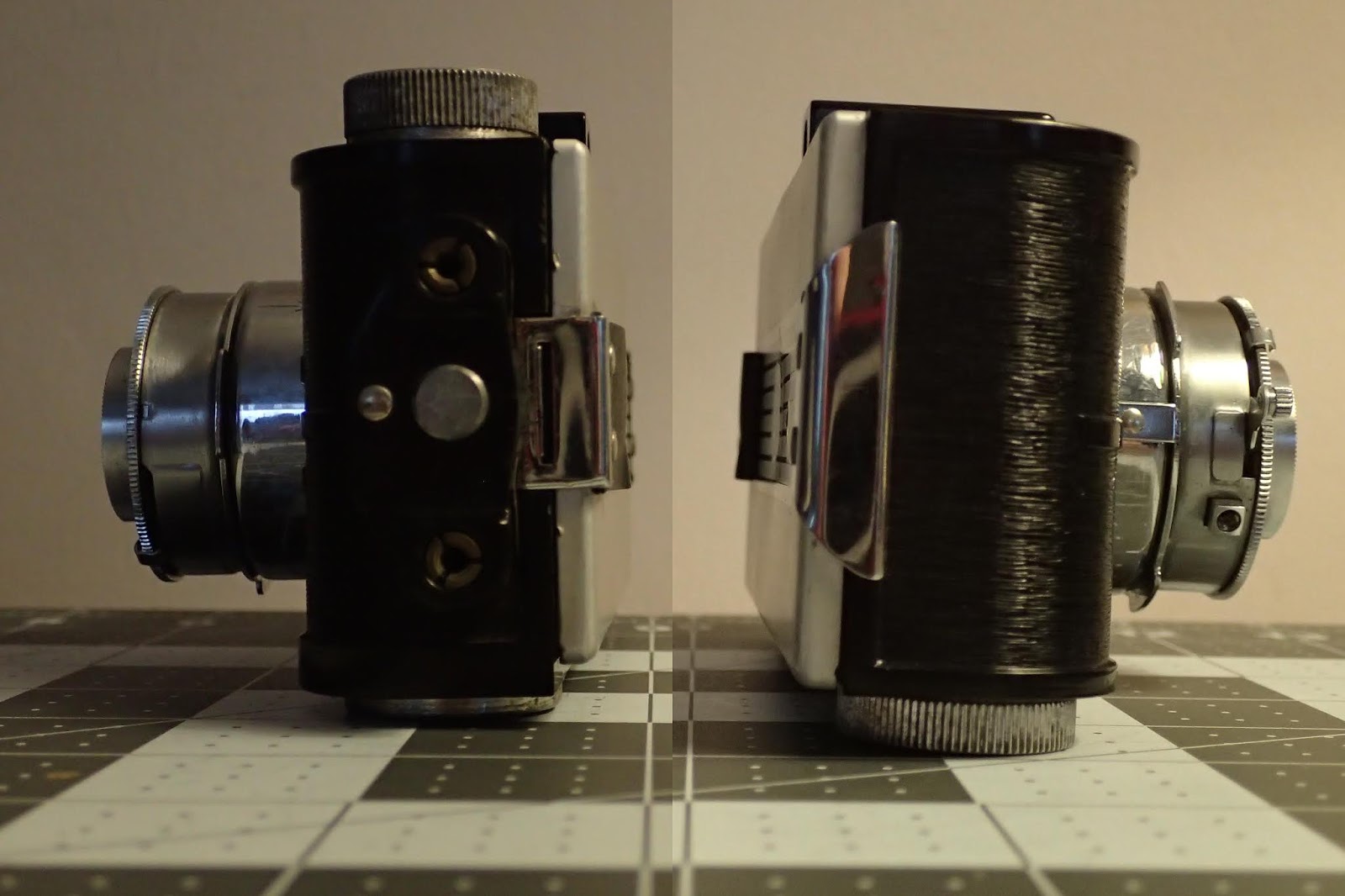
The auxiliary turret viewfinder for the C44R was made in Lichtenstein.  Rotating the front dial sets the field of view for a 35 mm, 50 mm or 100 mm lens.  A dial on the back can be set to the subject distance to correct for parallax.  The viewfinder fits in the flash shoe and has a socket for a flash extension.  I think this is the nicest of the Argus auxiliary viewfinders.  You want to use the turret viewfinder with the 50mm f/1.9 lens because that lens and hood partially block the in-camera viewfinder.

Argus Turret Viewfinder Front

Argus Turret Viewfinder Back

The C44R uses the selenium cell CM-2 light meter.  The light meter couples to the shutter speed dial and the needle on the meter points to the appropriate f/stop for the lens.

The C44R was the fanciest 35mm camera made by Argus.  The lens mount is a little fiddly, but makes a positive connection.  The light meter interferes a little with getting a good grip on the camera.

CM-2 Light Meter


Thursday, April 2, 2020

Kodak Retina Nr 126 (1936-1937)

Made by Kodak AG - Dr Nagel Werk in Stuttgart-Wangen, Germany, this camera is an improved model of the original scale-focusing Kodak Retina. In November 1937, when the range finder focusing Retina II came out, this model became known as the Retina I. The Kodak Anastigmat EKTAR lens was made by Jos. Schneider & Co. Optische Werke, Bad Kreuznach, Germany. The Compur-Rapid shutter was made by F. Deckel, Munich, Germany. The cameras Kodak sold in the USA have an accessory clip for the Kodak Pocket Range Finder. The list price in 1937 was $57.50, equivalent in buying power to about $1,000 depreciated 2020 dollars.

Open

Front

Rear

Top

Bottom

Interior

This Retina came with an uncoated, f/3.5-f/16, 50 mm Kodak Anastigmat EKTAR, which is a tessar type lens with four elements in three groups. "Ektar" was Kodak's trademark for their best corrected lenses, and did not necessarily designate a particular lens design. The distance scale is in feet, and the closest focusing distance is 3-1/2 feet.

The shutter has speeds of 1, 1/2, 1/5, 1/10, 1/25, 1/50, 1/100, 1/250 and 1/500 seconds, plus bulb and time settings, and is not synchronized for flash. The shutter release and the film advance are not interlocked, making it possible to unintentionally double expose or skip a picture.

The camera takes 35mm film in the daylight loading cassettes ("magazines" in Kodakese) that are still made today. The top of the camera has an accessory shoe for a Kodak Pocket Range Finder. You read the distance to the subject from the range finder, and then transfer the distance to the lens. Otherwise you can estimate the distance by eye and rely on depth of field for sharp focus.

Eastman Anniversary Camera 1930

In 1930, Eastman Kodak Company gave to boys and girls born in 1918 500,000 cameras in the US and 50,000 more in Canada on the 50th anniversary of the Eastman Dry Plate Company. A free roll of film came with each camera. Supposedly all were given away in about two days. The camera was a No. 2 Hawkeye model C with brown leatherette, brass trim and a gilt foil label. It took size 120 film. Compared to the No. 2 Brownie there was only a single aperture stop and no provision for making a time exposure. This example is in rough shape and the handle is missing. It came from Goodwill with a batch of other cameras.

Front

Back

Fiftieth Anniversary Seal

Saturday, March 14, 2020

Kodak Retina Reflex (1958-1959)

The Kodak Retina Reflex was introduced in the USA in 1958 and discontinued in 1959, when it was replaced by the Retina Reflex S. About 65,000 were produced by Eastman Kodak Company's West German subsidiary, Kodak AG - Dr Nagel Werk, in Stuttgart-Wangen. The original US list price was $215, which had the purchasing power of three weeks' earnings at the average wage in 1958 or approximately 1,940 depreciated 2020 dollars.

Front

Back

Top

Bottom

Interior

The Retina Reflex has a light alloy body with chrome and black leather trim. The controls are like those on the folding rangefinder Retina IIIC. The top of the camera has the film rewind knob, with a film reminder dial, an accessory shoe, the film counter, the film counter release button, the shutter button, and the light meter dial. The front of the camera has the light meter photocell, the flash sync connector, the aperture and shutter speed settings, and the focusing dial. The back of the camera has the viewfinder eyepiece and the setting button for the film counter. The bottom of the camera has the film door latch, the rewind release button and the film advance lever.

The standard lens is a Schneider-Kreuznach Retina-Xenon C f/2 50mm lens. The lens is a convertible lens: the front component is interchangeable with a Retina Curtar Xenon C f/4 35mm component or a Retina Longar Xenon C f/4 80mm component. The interchangeable lens system was introduced by the Retina IIc and IIIc folding rangefinder cameras in 1954. The f/5.6 35mm component for the Retina folding rangefinder cameras will fit the Retina Reflex camera.

The shutter is a Synchro-Compur leaf shutter. Shutter speeds run from 1/500 second to 1 second. The flash sync lever can be set to M for flash bulbs or X for electronic flash. Electronic flash is synchronized at all shutter speeds. The V setting provides a self-timer.

The operation of the shutter is fairly complicated. When the film is advanced, a blind swings down to cover the film, the mirror swings down and the lens shutter opens to allow viewing and focusing. The shutter remains open until the shutter button is pressed. When the shutter button is pressed, the shutter closes, the mirror and blind swing out of the way, the aperture stops down, and the shutter opens and closes. The shutter remains closed until the film is advanced again.

There was a brief vogue for leaf shutter single lens reflex cameras in the '50s and '60s. Zeiss Ikon had the Contaflex line, Voigtlander had the Bessamatic and the Ultramatic lines, Wirgin produced the Edixa Electronica and a number of Japanese manufacturers including Kowa, Mamiya, Nikon and Ricoh produced leaf shutter SLRs. Hasselblad cameras are medium format leaf shutter SLRs. 35mm cameras with focal plane shutters proved to be more reliable. At least they sold better.

The aperture and shutter speed settings are interlocked on the exposure value (EV) system. You can read the exposure value from the meter and adjust the shutter speed and aperture to the correct EV on the red scale on the lens. Once the EV is set changing the shutter speed changes the aperture to produce the same EV. For example, shutter speed 1/125 and aperture f/11 produce an EV of 14. If you change the shutter speed to 1/500 the camera automatically changes the aperture to f/5.6, and produces the same exposure on the film. If you want to set a particular shutter speed and aperture directly, you first set the shutter speed and then set the aperture. If the aperture is set first, changing the shutter speed will change the aperture. The Kodak Pony IV worked similarly.

The light meter is just like the one on the Retina IIIC. It has a selenium photocell that powers a galvanometer. No batteries are needed. You turn the dial to match the needles in the window and read the exposure value fron the dial. The film speed range is from 5 to 1300. The exposure value range is from 2 to 18.

Apart from the exposure value system, operation of the camera is like most other 35mm SLRs, except that the film advance lever is on the bottom, the film rewind knob doesn't have a fold-out crank and the mirror doesn't instantly return after the exposure. The non-return mirror does make for quieter than average operation. The blacked out viewfinder is an obvious reminder that you need to wind the film. The camera is fairly heavy for its size.

This example had been stored inside its leather case, and the acids in the leather have caused a little verdigris on the chrome plated brass cover. The lesson is that cameras shouldn't be stored inside their cases for long periods. Cases serve to protect the camera from bumps and bangs while it is out and about, but aren't good for long term storage.

Saturday, February 22, 2020

Kodak No. 2 Brownie Model D

The Brownie camera was designed by Frank Brownell to meet George Eastman's goal of making a camera that was simple and inexpensive enough for children to use. A Brownie was an everyday picture taker, like the smartphone of today. If there was a camera in an American home during most of the 20th century, the chances are it was a Brownie. The first camera with the Brownie name was made in 1900 and the last was made in 1986. About 100 different cameras had the Brownie label.

No. 2 Brownie


This No. 2 Brownie Model D, with a metal nameplate on the back, would have been made some time between December 1917 and March 1919 in Rochester, NY, by Eastman Kodak Company. The different versions of the No. 2 Brownie were produced in the millions from 1901 through 1933. The No. 2 designation referred to the picture size. A No. 2 Brownie took a 2-1/4" by 3-1/4" picture on size 120 film. There also were No. 0 Brownies (1-5/8" by 2-1/2" pictures on "vest pocket" size 127 film), No. 1 (2-1/4" square pictures), No. 2A (2-1/2" by 4-1/4"), No. 2C (2-7/8" by 4-7/8") and No. 3 (3-1/4" by 4-1/4") Brownies.

The Model D has a wood and jute board body covered with leathette, a simple meniscus lens (about 4-1/2" focal length), three aperture stops (about f/16, f/22 and f/32) and a rotary shutter (instantaneous or time). The instantaneous shutter speed is in the neighborhood of 1/25 to 1/50 of a second. The shutter has a flip-flop action. Pushing the shutter lever down would make an exposure and pulling it back up would make another exposure. Hopefully you advanced the film between flips and flops. There was no double exposure prevention. Ordinary daylight pictures with the relatively slow film of the 1918 era would be taken with the f/16 stop. The fixed focus lens produces a clear picture of subjects 8 ft. or more distant. There are two reflecting finders for pictures in either a vertical or horizontal orientation. A reflecting finder has a small lens and a mirror that projects an image of the scene onto a ground glass viewing screen. The image is upright but reversed and a little dim.

The Brownie is such a simple camera that this one still works after 100 years. The list price in the 1918 catalog was $2.75, or about $60 in depreciated 2019 dollars. A roll of No. 120 Kodak Non-Curling film for 6 pictures was 20 cents. Modern 120 film with eight 2-1/4"x3-1/4" pictures per roll will work in this Brownie.  Size 120 film is readily available today from Kodak and other makers.

One odd bit of history is that the design of the lens on a No. 2 Brownie is older than photography. The English chemist and physicist William Hyde Wollaston devised the Wollaston Landscape Lens for use in an artist's camera obscura in 1812. The landscape lens had a positive meniscus lens with the concave face toward the subject and an aperture stop in front of the lens, exactly the same as in a No. 2 Brownie. The advantage of this design was that it gave a fairly wide clear field of view compared to an ordinary lens.

Battle of Nashville Monument Park

A sample picture on Ilford Ortho Plus film. I used an orthochromatic film that is relatively insensitive to red light to get a look like the old Kodak N.C. film, also an orthochromatic film, that was available when this camera was made.

Wednesday, January 29, 2020

Kodak Retina IIc (1955-1958)

The Kodak Retina IIc is a convertible lens Retina that is functionally the same as the Retina IIIc (see the post for October 4, 2018), except for the lens (f/2.8 50mm instead of f/2 50mm) and the lack of a built-in light meter. The IIc did have an accessory shoe where you could attach a "Kodalux" light meter. A modern Sekonic L-208 Twinmate light meter fits just fine.  The IIc is barely smaller than the model IIIc that has a built-in light meter. 

Kodak Retina IIc

The front set of lens elements is replaceable to change the focal length from 50 mm, using the standard Schneider-Kreuznach Retina Xenon C set, to 35 mm, using the wide angle f/5.6 Retina Curtar Xenon C set, or 80 mm, using the telephoto f/4 Retina Longar Xenon C set (the post for October 30, 2018, shows a convertible lens on a Retina IIIc).

With the camera closed the lens is behind a door on the front of the camera. Pressing a button on side of the door lets it open to bring out the lens and shutter. To close the camera the photographer sets the focus to infinity (the camera won't close otherwise and forcing it can break the camera), presses two buttons on the top and bottom of the lens to unlatch the lens and close the lens door.

The latch for the film door is under a rotating cover on the bottom of the camera. To open the film door the photographer turns the cover and presses the revealed button. The rewind knob can pop up to allow the film cassette to be loaded. After loading the film the film counter needs to be set to the number of exposures on the film by pressing a button on the top of the camera and wiggling a button on the back of the camera. The film counter counts down to one and will not allow the film to be advanced after the last exposure is made. The film advance is a lever on the bottom of the camera. Advancing the film cocks the shutter. To rewind the film the photographer presses the clutch button on the back of the camera and turns the rewind knob until the film is back inside the cassette, when it is safe to take the film out of the camera.

Focusing is through a combined rangefinder-viewfinder window. The rangefinder patch is a bright diamond in the center of the viewfinder. The viewfinder also has frame lines for composing the picture. Earlier models of the Retina did not have frame lines.

The shutter is a rim set shutter and the aperture settings are coupled to the speed rim for using the exposure value system. The photographer would set the shutter speed, then set the aperture. A spring loaded latch would couple the aperture to the speed rim so that the aperture would follow the shutter speed. For example, 1/125 second at f/8 gives an exposure value of 14, and changing the shutter speed to a different value such as 1/500 would change the aperture to f/5.6, keeping the exposure the same.

The shutter is synchronized for flash using type M flashbulbs (M setting) or electronic flash (X setting). A self timer was available (V setting) that gave about a 10 second delay on releasing the shutter.

The list price in 1955 was $135, or about $1,300 in depreciated 2020 dollars. This was about a quarter the price of a Leica or Contax. Roughly 136,000 were made at Kodak's factory in Stuttgart, West Germany.

Friday, January 24, 2020

Argus FA (1950-1951)

Argus added a flash attachment to the A-series body to create the model FA. This was the last camera Argus made using the body style of the Argus A. It was followed by the A4 (see the post for September 16, 2019), which had a more modern appearance.

Argus FA

The back is striped instead of having the three rectangles of the other A body Arguses.


The flash attachment (left) takes the same flasholder as the Argus 75 or 40 twin lens cameras. The flasholder for the Argus C3 will not fit.

Instead of a serial number, a date (YYMM) was stamped inside the back. This one has March, 1951.

The FA has a coated f/4.5 Argus 50mm anastigmat in a self-setting shutter with speeds of 1/150, 1/100, 1/50 and 1/25 second plus B (bulb) and T (time). The 1/100 speed setting is red to indicate the shutter speed setting for an average daylight picture and the 1/25 setting is green to indicate the shutter speed setting for a flash picture. The aperture settings were marked f/4.5, f/5.6, f/8, f/11, f/16 and f/22. The 8 is red to indicate the aperture setting for an average daylight picture. The shutter has a cable release socket. The flash attachment takes the same flasholder as the Argus 40 or the Argus 75. The flasholder for the Argus C3 will not fit.

The Argus Model FA is the only A-body Argus where the zone focus settings are actually marked.

Left: 15 ft. to Infinity. Right: 6 ft. to 15 ft.

The list price in 1951 was $29.95 plus $4.08 for the flasholder and $5.50 for the case, the total of $39.53 being equivalent in purchasing power to $392 in depreciated 2019 dollars. The Argus FA apparently was not a commercial success, and stayed in the product line for only a couple of years.

The wire from the shutter to the flash contact is broken in this example. Since the flasholder is for flashbulbs only and flashbulbs aren't being made any more, I don't think I will try to replace the wire.