Monday, July 10, 2023

A home-made remjet removal bath

An at-home pre-bath for removing the remjet layer from Kodak Vision3 motion picture film.

Start with about 800 mL of distilled water.
Add about 156 g of washing soda (sodium carbonate decahydrate) and stir until dissolved.
Add about 19 g of baking soda (sodium bicarbonate) and stir until dissolved.
Dissolve the solids completely, then add enough distilled water to make 1 L.

The pre-bath will have a pH of about 10 (alkaline).  The solids are easy to dissolve.  Washing soda and baking soda are not dangerous.   If you don’t already have them at home, you can find washing soda in the laundry section of a supermarket and baking soda in the baking section.  Washing soda and baking soda are cheap enough that the pre-bath can be used once and thrown away.  You can filter and save the pre-bath for reuse if you're frugal.

To use, load the developing tank with film, then fill the tank with the pre-bath. Agitate vigorously and continuously for about 3 minutes.  Pour out the pre-bath.  Wash by filling the tank with tap water, agitating for about a minute, and dumping the water.  Repeat the washes until the water comes out clear and wash once more for good measure.  It will take several washes.  The pre-bath and wash water need to be close to the temperature of the developer you are going to use, usually 41 C (106 F).  After the remjet is removed you can develop the film following the instructions for your favorite C-41 or ECN-2 developing kit (like the FPP C-41 Home Development Kit or the FPP ECN-2 Home Developing Kit from the Film Photography Project Store).  After the final rinse I like to dunk the developed film in Photo-Flo diluted 1:200 with distilled water before hanging it up to dry.  While the film is hanging I use Kimwipes wetted with diluted Photo-Flo to wipe off the last of the remjet from the base side of the film.  Kimwipes won't scratch or leave lint.  You can get them from Amazon and others.

My recipe is based on the sodium carbonate pre-bath recipe from the Kodak publication Processing KODAK Motion Picture Films, Module 7, Process ECN-2 Specifications, which you can download from https://www.kodak.com/content/products-brochures/Film/Processing-KODAK-Motion-Picture-Films-Module-7.pdf.  Here is the Kodak sodium carbonate pre-bath recipe:

I replaced the anhydrous sodium carbonate with sodium carbonate decahydrate (washing soda).  The molar mass of the decahydrate form is 286 and the molar mass of the anhydrous form is 106, making the required ratio of decahydrate to anhydrous 286/106.  58 times 286 divided by 106 gives 156 as the weight of sodium carbonate decahydrate needed.  Because I used distilled water, I omitted the KODAK Anti-Calcium, No. 4, which is normally used to prevent calcium scum forming due to hard water.  I also omitted the Kodak Stabilizer Additive (TRIDECETH-4 according to information in the MSDS), which is a surfactant.  It probably helps to un-stick the remjet layer from the base side of the film.  The pre-bath seems to work well enough without it.  I kept the sodium bicarbonate (baking soda), which probably acts as a buffer.  You might be able to omit the baking soda and increase the washing soda to compensate.  I used a digital kitchen scale to measure weights.  I don’t think you need to be very precise.  Supermarket washing soda and baking soda aren't exactly chemically pure, anyway.  By the way, 156 grams of washing soda is about 2/3 cup and 19 grams of baking soda is about 1 tablespoon plus 1 teaspoon in kitchen measures.

Because solutions mixed from color developing kits have limited shelf lives, it is a good idea to save up your exposed color film and process several rolls at once in freshly mixed solutions.  Some remjet will remain in the developing tank when you are finished developing.  The tank and reels will need to be washed with soap and water.

Tuesday, March 28, 2023

Ciro-Flex / Graflex 22 Twin Lens Reflex (1940-1956)

A twin lens reflex camera has a taking lens to focus the image on film and matching viewing lens to focus the image on a ground glass focusing screen.  The rays of light from the viewing lens are reflected straight up by a diagonal mirror to make an image on the horizontal ground glass.  The lenses are synchronized so that the image on the film will be in focus when the image on the ground glass is in focus.  The image on the ground glass is upright, but reversed left for right.  

Twin lens reflex cameras using 120 film were first produced in Germany prior to WWII, when Francke and Heideke's Rolleiflex established the basic layout of the medium format twin lens reflex camera.  The war interrupted camera exports from Germany in 1939, giving US camera manufacturers the opportunity to fill that segment of the camera market.  Ciro, Inc. was one of the first to make a TLR, bringing out the Ciro-flex twin lens reflex camera in 1940.  The Franco-American engineer and inventor Rodolphe Stahl started Ciro in Detroit, Michigan, and relocated to Delaware, Ohio, after the Second World War. The entire camera line was sold to Graflex, Inc. in 1951 and production was moved to Rochester, NY.  Graflex renamed the Ciro-flex the Graflex 22, making a few minor changes but keeping the same basic design. Graflex discontinued twin lens reflex cameras in 1956.

The original Ciro-Flex had an uncoated f/3.5-f/22 85mm Wollensak Velostigmat taking lens and an f/3.2 85mm anastigmat viewing lens.  The shutter was a Wollensak Alphax with speeds from 1/200 second to 1/10 second.  It was not synchronized for flash.  The taking and viewing lenses had three elements in three groups.  The camera had black leatherette and black enamel finish.  The camera was discontinued when Ciro switched to war production in 1942.

The post-WWII model B had specifications similar to the pre-WWII model.  The taking lens was an f/3.5-22 85mm Wollensak Velostigmat with anti-reflection coatings ("Wocote") and the shutter was a Wollensak Alphax.  All of the post-WWII Ciro-flexes had coated lenses.

The model C had a Wollensak f/3.5-f/22 Anastigmat taking lens and a 1/400 second to 1 second Rapax shutter but was otherwise the same as the model B. 

The model D was the same as the model B with the addition of flash synchronization. The flash synchronizer had a built-in 20 millisecond delay.  The designation of the taking lens was changed from Velostigmat to Anastigmat.  As far as I know the lens design wasn't changed, only the name.

The model E was the same as the model C with the addition of flash synchronization. The flash synchronizer had a built-in 20 millisecond delay. 

The model F had an f/3.2 83mm Raptar taking lens (a Tessar type with four elements in three groups) and a Synchromatic Rapax (1/400 to 1 second) shutter with a variable delay (5 milliseconds to 20 milliseconds) synchronizer for flash.

The later cameras had fresnel field lenses under the ground glass.  The field lenses corrected for the light fall-off on the corners of a plain ground glass.

After Graflex took over production there were a number of other changes.  The models B and C were dropped. The Ciro-flex model D was made with little change until it became the Graflex 22 model 200 with some mostly cosmetic changes.  The model E likewise continued for a while until it was renamed the Graflex 22 model 400.  The model F became the Graflex 22 model 400F.  The names on the shutters were changed on the Graflex 22 models from Alphax to Century, and from Rapax to Graphex.  Graflex had already used the Century and Graphex names for Wollensak shutters on the Graphic series of press cameras.  Graflex adopted a gray color scheme for the Graflex 22 TLRs.  The rotating cover on the ruby window was changed to a sliding cover.  A hot shoe for flash replaced the ASA bayonet.  The second tripod socket on the side was removed.


This example is a Ciro-Flex model C with a coated f/3.5-f/22 85mm Wollensak Anastigmat in a Wollensak Rapax shutter. Shutter speeds are 1/400, 1/200, 1/100, 1/50, 1/25, 1/10, 1/5, 1/2 and 1 second plus bulb and time. The Rapax shutter has separate set and release levers. Generally, on a leaf shutter you want to the the shutter speed before you cock the shutter.  

The photographer needs to look through the little red window at the numbers printed on the backing paper of the film to count exposures and space the pictures. You open the shutter under the red window, wind the film to the next number, and close the cover to help prevent stray light entering the red wind and fogging the film. There is no interlock to prevent double exposures or skipped pictures. The numbers on the backing paper for Kodak and Ilford film are faintly printed and are a little harder to see through the red window than the numbers on the backing paper for Arista.EDU Ultra film, which has numbers in bold print. Picture size is 2-1/4" (57mm) square.  There are 12 pictures on a roll of 120 film (still available today).

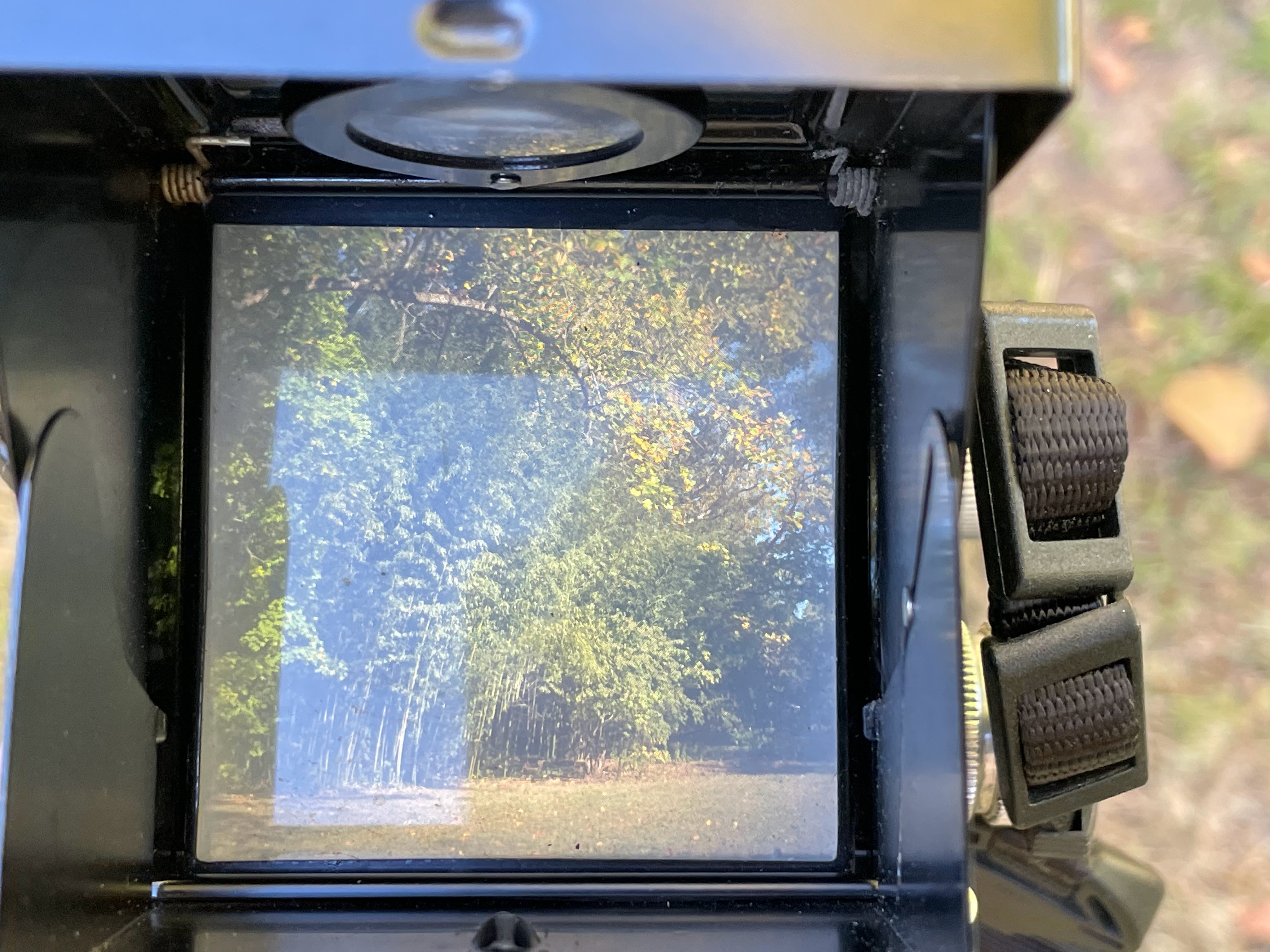
To focus and compose your picture you open the hood at the top of the camera and look down onto the ground glass screen.  The focusing screen is the same size as the negative, as usual with a twin lens reflex camera. The focusing screen has a fresnel field lens to improve the image brightness in the corners of the viewfinder. A flip up magnifier is there to enlarge the image for critical focusing.  For fast action shots you would open the sports finder on the front of the hood and zone focus the camera.

A new model C listed for $99.45 in 1950, equivalent to about $1,000 in depreciated 2018 dollars. The camera I have still takes a decent picture.


This picture of two readers on a bench at Sally Beaman Park, Nashville, TN, next to the Green Hills branch of the Nashville Public Library was taken with the Ciro-flex C and Kodak Ektar 100 film.


This is a Ciro-flex model F twin reflex camera made just after Graflex took over the Ciro-flex line and while it was still using the Ciro-flex name.   The camera body is formed from steel finished in black enamel paint with black leatherette and chrome knobs.  It has the typical twin lens reflex camera configuration.  1/4"-20 tripod sockets are on the bottom and the left side.  It weighs 2 lb. 5 oz. (1.05 kg) with a roll of film inside.

Normally the camera is held chest high so you look down at an image of the scene on the ground glass viewing and focusing screen.  The image appears upright, but is reversed left to right.  The camera focuses by moving the lens board.  The viewing lens and the taking lens move together so that an image in focus on the ground glass will be in focus on the film.  A fresnel lens under the focusing screen corrects some of the fall off of light in the corners that you get with a plain ground glass.  There is a flip-up magnifying glass to help focus the camera.  A folding hood shields the ground glass from stray light, but the image can still be difficult to see in bright sunlight.  A lever on the back pops up the hood.  The front of the hood folds back to make an open frame sports finder that you can look through with the camera held at eye level.  The sports finder is useful when you try to follow fast action.

The focusing knob has distance and depth of field scales for zone focusing.  The depth of field scale is based on a 0.066 mm circle of confusion.

The taking lens is a coated, f/3.2-f/22, 83mm, Wollensak Raptar lens.  The lens is a Tessar type with four elements in three groups.  It uses 1-5/16" (33mm) Series VI filter adapters.

The shutter is a set and release Wollensak Rapax Synchromatic shutter.  The shutter has a speed ring that can be set to 1/400, 1/200, 1/100, 1/50, 1/25, 1/10, 1/5, 1/2 or 1 second,  "B" for bulb or "T" for time.  A socket for a standard cable release is provided.  The flash synchronizer lever can be set to off (no flash), X-F (electronic flash or 5 millisecond delay flash bulbs) or M (20 millisecond delay flash bulbs).  The shutter speed ring and the synchronizer lever should be set before the shutter is cocked.  The synchronizer settings and shutter speeds are color coded.  The black synchronizer settings are used with the black shutter speeds and the red synchronizer settings are used with the red shutter speeds.  The flash connection is an ASA standard bayonet on the side of the camera.  If you want to use a modern electronic flash you will need to find an ASA bayonet to PC sync connection adapter.

The camera takes size 120 roll film.  To load film you open the back by pushing down the knob located near the top edge, putting the fresh film in the chamber at the bottom and threading the backing paper into the take up spool at the top.  You close the back and turn the film winding knob until you see the number 1 in the red window, which puts the first section of film in position for taking a picture.  The red window has a cover to prevent stray light from fogging the film.  You open the cover while advancing the film and close it after the film is in position for the next picture.  Because the camera does not have an automatic film counter, you space the pictures on the film by looking through the the red window at the numbers on the film.  The film advance and the shutter are not interlocked.  Accidental double exposures or skipped frames are possible.  Graflex recommended advancing the film immediately after taking a picture.  When all 12 pictures have been taken, you wind the roll completely onto the take up spool, remove the exposed roll from the camera and seal the roll.  You then move the empty spool from the bottom to the top to be ready for reloading.


This picture of a fisherman was taken from Lock Two Park, Nashville, Tennessee,  looking across the Cumberland River in the direction of the mouth of Gibson Creek.  The park is the site of a navigation lock built by the US Army Corps of Engineers in 1892-1907.  The purpose of the dam and lock was to allow the passage of steamboats over a shallow part of the river.  The old dams and navigation locks on the Cumberland were replaced by larger and more modern dams and locks after the Second World War.  The dam and most of the lock at this location were removed about 1956.  Only the lock wall on the land side is visible.

The Model F is fairly easy to use.  The image on the ground glass screen can be a little difficult to see in bright sunlight.  The lens is reasonably sharp.  


Friday, January 20, 2023

Kodak Duaflex Camera Series (1947-1960)

The Kodak Duaflex Camera is a simple 620 film camera with a large brilliant finder in a twin lens reflex configuration. Cameras were produced by Eastman Kodak Company in Rochester, New York, from 1947 to 1960.  The shutter is a single speed rotary shutter with a "bulb" setting.  The shutter speed is about 1/25 or 1/50 second. They came with two different lenses: a fixed focus Kodet lens (75 mm f/15) and a focusing Kodar lens (72 mm f/8).  The Kodet lens is a meniscus lens with an aperture stop behind the lens.  A Kodar lens is a three element anastigmat with front cell focusing from 3.5 ft. to infinity.  The Kodar lens has a lever to select an aperture of f/16, f/11 or f/8.  The stops are round holes in a metal plate, so you can't select intermediate f-stops.

The Duaflex (1947-1950) is black plastic and aluminum.  The ones with a focusing lens have a double exposure prevention device that locks the shutter button until you advance the film.  The ones with a fixed focus lens do not have double exposure prevention.  The flasholder is a dedicated model.

The Duaflex II (1950-1954) added a flip-up hood for the viewfinder.

The Duaflex III (1954-1957) added double exposure prevention to the fixed focus model.  The flash connection was changed to a pin-and-screw Kodalite connection.

The Duaflex IV (1955-1960) changed the color scheme from black to brown and tan, and added more exposure instructions to the focusing cameras.

Kodak Duaflex with Kodar lens.


Kodak Duaflex IV with Kodet lens.

A Duaflex makes the same size picture as the Brownie Hawkeye (https://fourelementsinthreegroups.blogspot.com/2018/11/front-back-this-brownie-hawkeye-was.html). It is a sunny day snapshot camera, similar to the Argus Seventy-five (https://fourelementsinthreegroups.blogspot.com/2019/09/argus-seventy-five-1949-1958-and-argus.html) or the Ansco Anscoflex (https://fourelementsinthreegroups.blogspot.com/2020/06/anscoflex-1953-1956.html). It was made for slow to moderate speed black and white (Verichrome, Plus-X) or color negative (Kodacolor) film. Current 120 films respooled onto 620 spools work fine.

Children's Memory Garden, Centennial Park, Nashville, Tennessee

The Children's Memory Garden was dedicated October 18, 2022.  It contains names of children who died violently in Nashville.  I was visiting the park this January and noticed someone had left a rose.  Kodak Duaflex with Kodar lens.  Arista EDU Ultra 100 film developed in XTOL.  Cropped from the original square to a portrait orientation.


Sunday, January 8, 2023

Lithagon Lenses for the Geiss Modified Argus C4

In 1954 Geiss-America, Inc. began selling a replacement lens mounting and a series of interchangeable lenses for the Argus C4. Geiss-America was an importer of West German photo equipment. The lenses were made by Enna-Werk, Munich.


Left - Right: f/4.5 35mm, f/1.9 45mm, f/4.5 100mm, f/3.5 135mm Lenses.
Center: Sandmar Zoom-Vue Viewfinder.

The initial set of lenses included an f/4.5 35mm and an f/4.5 100mm. An f/1.9 45mm and an f/3.5 135mm lens came out later. The unmodified Argus C4 camera had a fixed f/2.8 50mm Argus Cintar lens. The modified camera got a new, interchangeable lens mounting.  The existing standard, f/2.8 50mm lens was modified to fit the new lens mounting. Geiss would modify either new or used C4 cameras. Geiss sold a Sandmar Zoom-Vue auxiliary viewfinder for the Lithagon lenses.

The large lens hood for the 135mm telephoto lens would have blocked the rangefinder.  To avoid that, the rear of the lens hood was made of glass so the rangefinder could see through it.  The alternative is to remove the lens hood.  The lens hood, being partly glass, was fragile.  You do see 135mm Lithagons without lens hoods.  Presumably the lens hoods were broken.

The 35mm and 45mm lenses will take modern 49mm screw-in filters.  Alternatively, either lens will take a 2" diameter Series VII adapter and Series VII drop in filters.  The 100mm lens will take a Series V drop-in filter between the lens and lens hood.  The 135mm lens will take a 52mm screw-in filter.

The C4 was discontinued in 1958. The next model, the C44, has a different lens mount and its own set of interchangeable lenses..


This camera has the standard f/2.8 50mm Argus Cintar modified for the Geiss mounting.

Geiss modified Argus C-4

Catch closed.

Catch Open

Lever open.

Lens removed.

Index marks on the Cintar lens.

Camera focused at infinity.

Lens reinstalled.

To change the lens the photographer put the camera on its back, then turned the knurled knob at the end of the lever to release the catch and moved the lever up. The old lens would be lifted straight out. Before installing the new lens the camera had to be set to focus at infinity. The new lens was set to line up the index marks, then lowered straight in, making sure that the gear teeth meshed. The lever would then be moved down and the knob turned to latch the lever. In use the lens mounting is more complicated than the lens mountings on modern digital cameras. It is easier to change the lens on a Geiss C4 than it is on an Argus C3. The degree of difficulty is about the same as on an Argus C44 or C33.

The lens can wobble on a camera with bent flanges on the lens mount. When you look at the mount from the side the slots under the flanges will be spread apart. They should be straight as in this "after repair" picture. Unfortunately I did not make a "before" picture. You do the fix by pressing the flange to straighten the slot. You don't even have to take the mount off the camera.

The lens mount as seen from the side.

The long, thin slot should be straight. If it is spread apart the lens will wobble.

A Geiss modified C-4 with a Lithagon f/1.9 45mm lens and the Sandmar Zoom-Vue finder.


A wedding party crossing Legislative Plaza to the War Memorial Building on a sunny but cool Saturday afternoon. Picture taken on Ultrafine Xtreme 100 on a Geiss modified C-4 with an f/1.9 45mm lens. The state capitol building is in the background.

The War Memorial Building was built about 1925 as a memorial to Tennesseeans who were killed in action during the First World War. The doric order columns make a popular background for wedding photographs.

Monday, December 12, 2022

Kodak Retina Reflex S (1959-60)

The Kodak Retina Reflex S is the successor to the Retina Reflex. The main change was to have the complete lens interchangeable instead of just the front components. This allowed a wider range of focal lengths: 28 mm to 200 mm instead of only 35 mm to 80 mm. The original list price was $235. About 78,000 cameras were made in 1959-60 at the Kodak AG - Dr Nagel Werk factory in Stuttgart-Wangen, West Germany.


The Reflex S has a die cast metal body finished with black leatherette and chrome. The top of the camera has the rewind knob with a film reminder dial, an accessory shoe, the exposure remaining counter, the shutter release and the light meter. The front of the camera has the selenium cell for the light meter, a PC flash sync connector, and the lens mount. The shutter speed dial is around the lens mount and the aperture setting dial is at the bottom of the lens mount, next to the latch for the bayonet lens mount. The bottom of the camera has the film advance lever, the rewind clutch button, the tripod socket and the latch for the camera back.

The lens mount is the same Deckel bayonet used on the Retina IIIS range finder camera. Available lenses included a 28mm, a 35mm, two different 50mm, an 85mm, a 135mm and a 200mm. Setting the aperture is different from other 35mm SLRs. The aperture is controlled by a dial on the bottom of the camera instead of an aperture ring on the lens. The shutter speed is interconnected with the aperture so that the exposure value remains constant when the shutter speed is changed. For example, if the shutter speed is 1/500 and the aperture is f/2.8, changing the shutter speed to 1/250 changes the aperture to f/4 in order to keep the amount of light reaching the film a constant.

The exposure controls are coupled to the built-in light meter. Matching the yellow needle to the meter needle by turning the aperture setting dial matches the exposure value set on the camera to the light value read by the meter. The light meter can be set to film speeds from ASA 10 (DIN 12) to ASA 3200 (DIN 36).

The shutter on this example needs to be cleaned and re-lubricated.


Monday, November 28, 2022

120 Film

October, 2021, marked the 120th anniversary of size 120 roll film, introduced by Eastman Kodak Company in 1901 for the No. 2 Brownie camera.

Kodak Gold 200 Film. New in 2022

120 film consists of photosensitive film protected by opaque backing paper and rolled on a spool.  On a modern roll of film the film is roughly 32-1/2 inches (80 cm) long and 2-3/8 inches (6 cm) wide.  The backing paper is about 2 feet (60 cm) longer than the film and is slightly wider. A roll of film can be handled in ordinary room light as long as it is tightly rolled on the spool.  A strip of adhesive tape keeps the film from accidentally unrolling in the light before you load the camera.

Backing Paper

Depending on the camera, the film can hold eight 2-1/4" x 3-1/4" (6 x 9 cm), twelve 2-1/4" square (6 x 6 cm) or sixteen 2-1/4" x 1-5/8" (6 x 4.5 cm) pictures.  Picture numbers printed on the outer surface of the backing paper let the photographer space pictures on the film in cameras using the legendary little red window.  Many cameras automatically space and count pictures and do not require the red window, the more well-known probably being the Rolleiflex and Hasselblad.  Some cameras like the Pentax 6x7 automatically make 10 6x7 cm pictures on a roll without regard to the numbers on the backing paper.

The image on 120 film can be more than twice the height and width of the image on 35 mm film; therefore, less enlargement is needed to produce the final print.  This makes for less visible grain and smoother tones.  Kodak No. 2 Brownie cameras using 120 film produced negatives capable of making passable album-size, 2-1/4" x 3-1/4" contact prints.  A contact print is made by placing the negative in a printing frame, putting the emulsion side of the paper against the emulsion side of the negative and exposing the paper to light through the negative.  The paper is then developed and fixed.  The picture on the resulting print is exactly the same size as the negative.  The size of the contact print you wanted determined the size of the camera you used.  If you wanted a big picture you used a big camera.  Improvements in film and lenses now make it possible to get big pictures from small cameras.

120 film did not get the number 120 until 1908.  Kodak used to list the cameras that took a film on the film box and you specified the Kodak film you wanted by giving the name of the Kodak camera it fit: "I want a roll of film for a No. 2 Brownie."  As Kodak made more and more types of films and cameras, this system became cumbersome.  To solve the problem Kodak numbered all of the sizes of roll film it made, starting with size 101.  Some sizes were not strictly in numerical order, some numbers were reused and the last new size to be made was 240 (Advantix or Advanced Photographic System film in the 1990s).  120 film was also known as B2 or B II film in Germany.  The "B2" likely referenced the No. 2 Brownie. Kodak still makes roll film for still cameras in 120 ("medium format") and 135 ("35 mm film") sizes.  There are about a dozen brand names of 120 film, including Fujifilm, Ilford and Kodak, available at present. Because there is an international standard for the dimensions of 120 film all 120 film will fit all 120 cameras.

Prior to about 1930, Kodak 120 film was shorter and had room for only six 2-1/4" x 3-1/4" pictures; however, old cameras made for the original six-picture 120 film will take modern eight-picture 120 film.   The first spools for roll films had wooden spindles with metal flanges.  Later production spools had metal spindles and flanges. Current 120 spools are injection molded plastic.  Kodak called roll film with backing paper on a spool a "cartridge."

100 Years of Film

The Kodak Non-Curling Film in the box on the left was Kodak's standard snapshot roll film from 1903 to 1933.  The spools in the middle are empty 120 spools from different eras.  The first spools had wooden cores with metal flanges.  Beginning in the 1930s the spools were all metal.  In the modern, plastic age the spools are injection molded plastic.  The roll film on the right is a modern roll of Kodak Tri-X.

Monday, October 31, 2022

Argus A (1936-1942)

The insignificant looking Argus A is one of the most commercially significant 35mm cameras ever produced because it is the camera that popularized 35mm photography in the US.  In 1936 the Argus model A was the first camera to be built in the United States to use 35mm film in Kodak's 135 film magazines.  The magazine had been designed to fit Leica, Contax and Retina cameras.  The Argus is no Leica, but it does take a picture.

International Radio Corporation was a radio manufacturer in Ann Arbor, Michigan, in the 1930s. Company President Charles A. Verschoor wanted a new product to keep his factory busy during the summer, when radio sales tended to fall off. The result was the Argus Candid Camera. The Argus was intended from the beginning to be a mass market camera, originally selling for $12.50. Later the price was reduced to $10.00. 30,000 cameras were claimed to have been sold in the first week it was offered. About 210,000 were sold altogether. The Argus camera proved to be so popular that IRC got out of the radio business completely and changed its name to International Research Corporation. Eventually it became Argus Camera, Inc.


The camera body is molded from a phenolic resin. The back is stamped aluminum. The top of the camera has the film advance knob, the viewfinder, the film advance release button and the exposure counter. The bottom of the camera has the film rewind knob. For about the first year the camera came without a tripod socket. Later production had a tripod socket.


The camera has an f/4.5-f/11 50 mm anastigmat lens in a self-setting leaf shutter with speed settings from 1/25 to 1/200 second plus bulb and time. To make the camera a little more pocketable the lens is retractable. Three sets of fingers and flanges hold the lens in the retracted position. The lens has two focus settings: distant and close. The lens is set for the distant zone, 18 ft. to infinity, when the three flanges on the lens are between the three fingers on the camera body (fig. 7 and 8). It is set for the close zone, 8 ft. to 18 ft., when the flanges on the lens line up with the fingers on the body (fig. 5 and 6). The lens isn't marked to show which setting is for which zone. You just have to read the manual to know. Lenses and shutters originally were made by Ilex Optical of Rochester, NY. The lens takes a 23 mm Series V filter adapter.

When the camera first came out word got around that the lens was closer to f/6.3 instead of f/4.5. If you unscrew the front lens element and measure the iris diaphragm with the lens wide open you do get about an 8 mm diameter and 50 divided by 8 is 6.25. But that's not how it works because the strong positive front element causes the light rays to converge before they reach the iris. The focal ratio of a lens is the focal length divided by the diameter of the entrance pupil of the lens and the definition of the entrance pupil is the size of the aperture as seen from the front of the lens. Allowing for the strength of the positive front lens element you will get an f/4.5 focal ratio.

The camera takes currently available 35 mm film in standard cassettes. The film runs from right to left, which is the opposite direction from a Leica and most other 35 mm cameras. The exposure counter counts up. It needs to be manually set to zero after the film is loaded. To advance the film you press the film release, turn the wind knob a little, then let go of the film release and wind on until the film stops, just like an Argus C3. When the film is finished you rewind by turning the knob on the bottom. The camera doesn't have a film rewind catch. If you fiddle with the rewind knob between shots you could get overlapping pictures. You can check whether there is film in the camera by lightly turning the wind knob on the top of the camera. If there is film in the camera you can feel tension on the knob.

The viewfinder is a reverse galilean finder (negative lens in front, positive lens in back) without any frame lines or parallax correction. With a close focus of 8 ft., you don't need parallax correction.

The Argus Model A underwent some revisions during the seven years it was produced.  Here is an Argus Model A Timeline.

1936: The camera was introduced.

1936: A tripod socket was added.  The rewind knob assembly was changed.

1937: A second sprocket wheel was added.  The lens labeling was changed from “Argus Ilex Precise” to “Argus IRC Anastigmat.”

Early 1941: The aperture settings were changed from "f/11, 8, 5.6, 4.5" to "f/18, 12.7, 9, 6.3, 4.5."

Late 1941: The shutter speeds were changed from “25, 50, 100, 200, B, T” to “T, B, 150, 100, 50, 25.”  The labeling on the lens face was changed to drop the word “Anastigmat.”  The lens face was changed from brass to chrome.

1942: The camera was discontinued.

The Argus A is about as simple as an adjustable camera can be. It will produce good pictures if you keep within its limitations.   An Argus A today will make pictures that are as good as ever, modern films being so much better than films in the 1930s. With a fastest shutter speed of 1/200 second and a smallest aperture of f/11, this camera works best with 80-125 speed film for outdoor pictures on sunny days.  The later ones that stop down to f/18 will work well with 200 speed film.

Mid-train Motive Power

A CSX intermodal freight with distributed power at the Berry Road, Nashville, Tennessee grade crossing. The locomotive on the far track is in the middle of the train. A train is waiting on the near tack for the other to pass. From the parking lot of the Melrose branch post office. Argus A, f/11 at 1/200 second through an orange filter on Ultrafine eXtreme 400 film developed in Ultrafine powder developer. Ultrafine eXtreme 400 has been out of stock from the distributor for a while (Photo Warehouse - https://www.ultrafineonline.com/).  I don't know whether it will be available in the future.  Kentmere 400 would be the nearest equivalent.