


This example is a Ciro-Flex model C with a coated f/3.5-f/22 85mm Wollensak Anastigmat in a Wollensak Rapax shutter. Shutter speeds are 1/400, 1/200, 1/100, 1/50, 1/25, 1/10, 1/5, 1/2 and 1 second plus bulb and time. The Rapax shutter has separate set and release levers. Generally, on a leaf shutter you want to the the shutter speed before you cock the shutter.
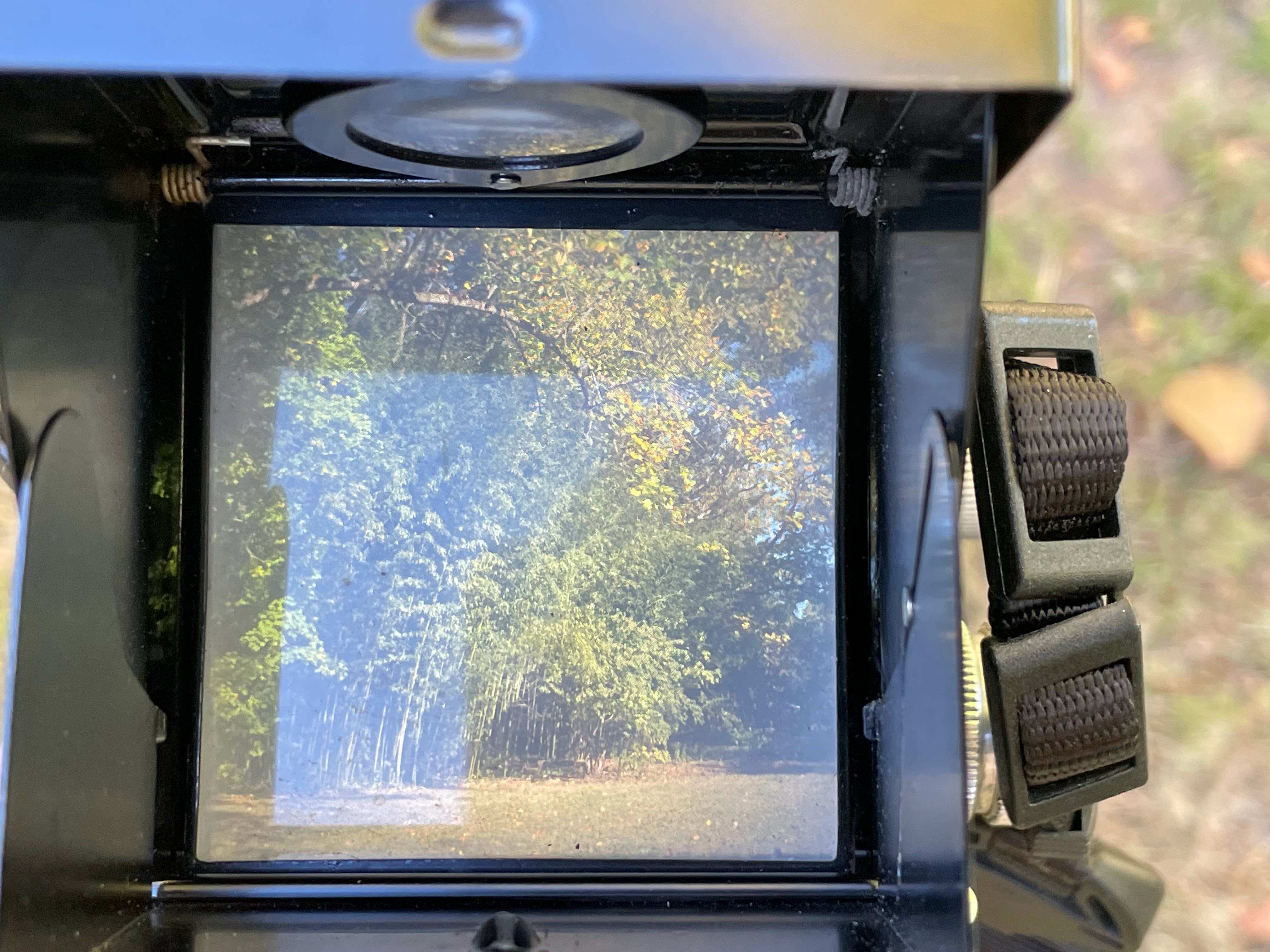
To focus and compose your picture you open the hood at the top of the camera and look down onto the ground glass screen. The focusing screen is the same size as the negative, as usual with a twin lens reflex camera. The focusing screen has a fresnel field lens to improve the image brightness in the corners of the viewfinder. A flip up magnifier is there to enlarge the image for critical focusing. For fast action shots you would open the sports finder on the front of the hood and zone focus the camera.




This is a Ciro-flex model F twin reflex camera made just after Graflex took over the Ciro-flex line and while it was still using the Ciro-flex name. The camera body is formed from steel finished in black enamel paint with black leatherette and chrome knobs. It has the typical twin lens reflex camera configuration. 1/4"-20 tripod sockets are on the bottom and the left side. It weighs 2 lb. 5 oz. (1.05 kg) with a roll of film inside.
Normally the camera is held chest high so you look down at an image of the scene on the ground glass viewing and focusing screen. The image appears upright, but is reversed left to right. The camera focuses by moving the lens board. The viewing lens and the taking lens move together so that an image in focus on the ground glass will be in focus on the film. A fresnel lens under the focusing screen corrects some of the fall off of light in the corners that you get with a plain ground glass. There is a flip-up magnifying glass to help focus the camera. A folding hood shields the ground glass from stray light, but the image can still be difficult to see in bright sunlight. A lever on the back pops up the hood. The front of the hood folds back to make an open frame sports finder that you can look through with the camera held at eye level. The sports finder is useful when you try to follow fast action.
The focusing knob has distance and depth of field scales for zone focusing. The depth of field scale is based on a 0.066 mm circle of confusion.
The taking lens is a coated, f/3.2-f/22, 83mm, Wollensak Raptar lens. The lens is a Tessar type with four elements in three groups. It uses 1-5/16" (33mm) Series VI filter adapters.

The shutter is a set and release Wollensak Rapax Synchromatic shutter. The shutter has a speed ring that can be set to 1/400, 1/200, 1/100, 1/50, 1/25, 1/10, 1/5, 1/2 or 1 second, "B" for bulb or "T" for time. A socket for a standard cable release is provided. The flash synchronizer lever can be set to off (no flash), X-F (electronic flash or 5 millisecond delay flash bulbs) or M (20 millisecond delay flash bulbs). The shutter speed ring and the synchronizer lever should be set before the shutter is cocked. The synchronizer settings and shutter speeds are color coded. The black synchronizer settings are used with the black shutter speeds and the red synchronizer settings are used with the red shutter speeds. The flash connection is an ASA standard bayonet on the side of the camera. If you want to use a modern electronic flash you will need to find an ASA bayonet to PC sync connection adapter.

The camera takes size 120 roll film. To load film you open the back by pushing down the knob located near the top edge, putting the fresh film in the chamber at the bottom and threading the backing paper into the take up spool at the top. You close the back and turn the film winding knob until you see the number 1 in the red window, which puts the first section of film in position for taking a picture. The red window has a cover to prevent stray light from fogging the film. You open the cover while advancing the film and close it after the film is in position for the next picture. Because the camera does not have an automatic film counter, you space the pictures on the film by looking through the the red window at the numbers on the film. The film advance and the shutter are not interlocked. Accidental double exposures or skipped frames are possible. Graflex recommended advancing the film immediately after taking a picture. When all 12 pictures have been taken, you wind the roll completely onto the take up spool, remove the exposed roll from the camera and seal the roll. You then move the empty spool from the bottom to the top to be ready for reloading.
 |
The Model F is fairly easy to use. The image on the ground glass screen can be a little difficult to see in bright sunlight. The lens is reasonably sharp.


