Wednesday, January 19, 2022

David White Company Stereo Realist (1947-1971)

The Stereo Realist camera is the first 3D camera made for 35mm slide film. It was invented by Seton Rochwite and made by the David White Company. Seton Rochwite (1904-2000) was an electrical engineer (Marquette, 1929) and inventor. David White Company was a manufacturer of surveying equipment. About 125,000 cameras were made from 1947 to 1971.


The camera has a black and chrome, die cast aluminum body. The front of the camera has a flip up lens cover, a matched pair of lenses, the aperture rings around the lenses, the viewfinder window, the shutter speed dial around the viewfinder window, the shutter cocking lever and the two range finder windows. Under the lens cover is a depth-of-field table or an exposure table for Kodachrome film, depending on the particular version of the Realist. The back of the camera has the double exposure button, the film release button and the eyepieces for the viewfinder and rangefinder. The top of the camera has the rewind knob, the cable release socket, the shutter button, the shutter trip indicator, the flash shoe, the exposure counter, the film rewind/advance control and the wind knob. The bottom of the camera has the tripod socket and a latch to unlock the back of the camera. The focusing knob and a depth of field scale are on the right side. Strap lugs are on the left and right sides.

The lenses are coated, f/3.5-f/22, 35 mm cooke triplets. The camera is focused by moving the film plane, and the closest focus is 2-1/2 ft. The Realist makes two 23 wide by 25 mm high pictures of the same scene through a pair of lenses spaced about 70 mm apart. Pictures of one pair are 15 perforations apart on the film and the film is advanced 10 perforations for each pair. This interleaves the pictures on the film. The film gates and lenses are positioned so the lines of sight from the left and right lenses converge about 2 meters in front of the camera. This helps create the illusion of depth. Because the images are about five film perforations wide Realist format is also called 5P format. The Realist format was the most popular format for stereo slides and was used in stereo cameras from a number of other manufacturers.

The guillotine type shutters are located behind the lenses. Shutter speeds run from 1/150 second to 1 second plus bulb and time. The shutter is interlocked with the film advance to prevent an accidental double exposure. To make a deliberate double exposure or make a time exposure pull out the double exposure button.

To load the camera, turn the advance/rewind control to "R". Unlatch and remove the back. Push up the rewind knob, put the new film cassette in the film chamber on the left and push down the rewind knob, engaging the key in the film spool with the fork on the rewind shaft. Thread the film between the sprocket wheel and the guard, making sure the teeth on the wheel engage the sprocket holes on the film. Insert the film leader into the slot on the wind spindle. Turn the wind knob a little to make sure the film is moving properly. Replace and latch the back and turn the advance/rewiind control to "A". Press the film release button and turn the wind knob until it stops. Advance the film twice more. Turn the exposure counter counterclockwise to "1". It won't turn backward.

To take a picture, focus the camera, set the shutter speed, set the aperture, focus the camera on the subject, cock the shutter and press the shutter button. After taking the picture, press the film release button and advance the film for the next picture.

To unload the camera, turn the advance/rewind button to "R" and turn the rewind knob until the film is wound back into the cassette. Unlatch the back and remove the old cassette.


The flasholder uses three AA batteries and takes 5 or 25 bayonet base flashbulbs, or M miniature base bulbs using an adapter. The shutter syncs with flashbulbs at 1/25 second. A modern electronic flash adapter is available.


Series V drop-in filters fit the combination lens hood/filter holder. There also were available pairs of push-on haze filters for daylight film, flash filters for using tungsten balanced film with clear flashbulbs, and color correction filters for tungsten balanced film in daylight.


The film identifier was a gadget that let you shoot a picture of a 1-3/8 in. square card with information about that roll of film. The identifier slipped over the left-hand lens of the Realist. A positive lens in the identifier put the card in focus. An image of the card appeared on the otherwise wasted frame between the first and second stereo pairs at the start of the roll.

The Stereo Realist was made for 35mm Kodachrome slide film, which debuted in 1936. At the time Kodak had a monopoly on developing Kodachrome film, which required an specialized development process. Customers could have their film developed by Kodak and mounted in Realist 4 in. x 1-5/8 in slides by David White Co. or a dealer. Kodachrome is long gone, but the camera does have a wide enough range of settings for current Ektachrome or Velvia film. Stereo slide mounting is no longer commercially available. For do it yourself slide mounting I like to use the plastic slide mounts available on eBay from 3d-drt-3d. Transparencies can be viewed in a stereo slide viewer or projected. As an alternative to transparencies, you could use negative film and mount prints on stereo cards for viewing with a parlor stereoscopic viewer.


The stereo illusion is supposed to be strongest using the smallest aperture allowed by the available light in order to have the greatest of field, and with the nearest object about 2 meters or 7 feet in front of the camera. The camera needs to be level. Because the Realist has sharp edges, it is more comfortable to hold when it is in its leather case.

Friday, December 10, 2021

Minolta 110 Zoom SLR Mark II (1981-)

Minolta released an updated version of the 110 Zoom SLR (https://fourelementsinthreegroups.blogspot.com/2020/08/minolta-110-zoom-slr-1976-1979.html) in 1981. This model looks just like a small 35 mm SLR camera. According to a review in the March, 1981, issue of Popular Photography, the list price was $342 (not cheap). This example has the all lower case "minolta" on the nameplate. Later examples have the all upper case "MINOLTA" with the barred circle logo instead of an "O".


The top of the camera has the aperture and exposure compensation dial, the hot shoe, the exposure mode dial, the shutter release and the battery check/self-timer dial. The lens has the focusing ring, the zoom ring and the macro mode switch.


The bottom of the camera has the battery compartment, the tripod socket and the film advance lever.


The front of the camera has the battery check/self-timer LED.


The back of the camera has the eyepiece cover lever, the eyepiece diopter adjustment slider, the film door and its latch.


The left side is pretty plain, with only a strap lug.


A hand grip and strap lug are on the right side.

The lens is an f/3.5-f/16 25-67 mm zoom (equivalent to 50-135 mm on a 35 mm camera). The zoom ring is marked at 25, 30, 40, 50 and 67 mm. Apertures are set by a knob on the top of the camera. Apertures are marked at f/3.5, 4, 5.6, 8, 11 and 16. Click stops are at 1/2 stop intervals. The mormal close focusing distance is 1.1 meters (3 ft. 7 in.). With the macro function engaged the lens will focus from 200 mm to 890 mm (8 to 35 inches) to give 0.19x to 0.07x magnification. The lens has 12 elements in 10 groups, plus a macro focusing element that swings in when the macro function is engaged by moving the slider on the top of the lens.

The exposure mode is set by the dial on the top right of the camera. Functions are lock ("L"), auto ("A"), flash ("X"), and bulb ("B"). The lock setting turns off the camera and locks the shutter release. The auto setting lets the camera automatically set the shutter speed from 1/1000 second to 1/4 second according to the light level and film speed. The film speed is sensed by a feeler that reads a tab on the film cartridge and can be either "slow" (about 100) or "fast" (about 400). Flash mode sets the shutter to 1/125 second to sync with electronic flash. Bulb mode holds the shutter open for as long as the shutter button is depressed. The shutter button is threaded for a cable release. Pushing the BC-ST switch to the right starts the self timer. The LED flashes while the self timer is running. Pushing the switch to the left checks the battery. The LED lights to show that the battery has enough power.
The viewfinder has a split image focusing aid. Shutter speeds are displayed on the left for 1/1000, 1/500, 1/250, 1/125 and 1/60-1/4 second. Small triangles light at the top or bottom to show over exposure or too low a shutter speed. An eyepiece blind is provided to block stray light from coming through the eyepiece when using the self timer. The eyepiece can be focused for -1.1 to +0.8 diopter correction by a slider above the eyepiece. Stronger clip-in correction lenses were available in the range -4 to +3 diopters.

110 film comes in plastic drop-in cartridges. The cartridge only fits one way. The film advance is by the lever on the bottom left of the camera. The film advance stops automatically at the next picture. When the roll in finished you wind the film all the way onto the take up spool and send the cartridge the lab.


Minolta made the Auto 118X flash to go with the 110 Zoom Mk II. The flash had one automatic range for 100 speed film and another for 400 speed film. There also was a manual, full power, setting. On manual the flash had a guide number of 18 meters (59 feet) with 100 speed film. When the flash was turned on and ready to fire, an extra contact in the hot shoe received the flash ready signal to automatically switch the shutter speed to the 1/125 X-sync setting and light a flash ready LED in the viewfinder.. The manual X-sync setting on the camera was for use with flashes that did not have the dedicated flash ready signal.

Tuesday, November 30, 2021

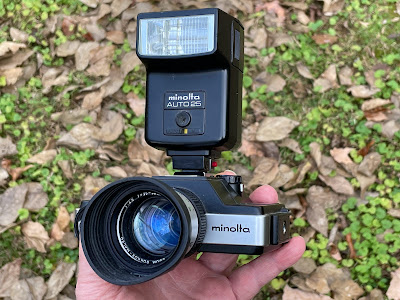
Minolta 110 Zoom SLR (1976-1979)

The Minolta 110 Zoom SLR is an aperture priority auto exposure, zoom lens camera for sub miniature size 110 film. It was made from 1976 to 1979 and was the first single lens reflex camera for 110 film. The list price was about $200 - $250. This was not a cheap camera.


The camera has the typical "ice cream sandwich" shape of a 110 camera with the addition of the lens barrel in front and a hump on top for the viewfinder. The camera uses two 1.5 V silver oxide SR76 dry cells. The top of the camera has the shutter mode selection dial, the flash shoe, the battery test button, the exposure compensation slide switch, the shutter button (threaded for a cable release) and the shutter lock. The front of the camera has the aperture selection dial and CdS light meter cell. The film advance lever is on the bottom. The tripod socket is on the left side and the battery compartment is on the right. The strap lugs are on the left and right. The back of the camera has the film door and window. The picture number and film cartridge label are visible through the window.

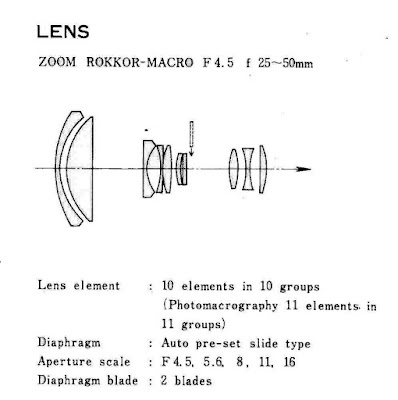
The lens is an f/4.5-f/16 25 mm-50 mm zoom macro (roughly equivalent to a 50 mm - 100 mm zoom on a 35 mm camera) with 10 elements in 10 groups. The zoom ring on the lens is marked for 25 mm, 30 mm, 35 mm, 40 mm, 50 mm and macro. The lens focuses as close as 1 meter in the normal focusing range. An 11th lens element moves into place when you turn the zoom ring to the macro setting and the camera then focuses from 30.7 cm to 28.6 cm. The lens takes 40.5 mm screw-on filters. The aperture is manually set by a dial surrounding the CdS light sensor.

A dial sets the exposure mode to "A" (auto), "X" (flash) or "B" (bulb). The dial has a silver latch button to prevent accidentally turning the dial. In auto mode a feeler inside the camera engages a tab on the film cartridge to set the film speed to low (about ISO 100) or high (about ISO 400) and the shutter is electronically timed from 10 seconds to 1/1000 second. Plus or minus 1 to 2 stops of exposure compensation is provided for unusual lighting conditions. In flash mode the shutter is set at 1/150 second. In bulb mode the shutter is open as long as the shutter release is pressed. Flash mode and bulb mode will work without battery power. In a pinch, if the battery runs out exposures can be made outdoors without an electronic flash by setting the mode to "X" and setting the aperture manually for 1/150 second shutter speed. For example, f/11 with 100 speed film on a sunny day.


The shutter syncs with electronic flash at 1/150 second. The camera will not work with flash bulbs. A companion Minolta Auto 25 electronic flash unit was available. A switch on the front of the Auto 25 can be set for manual flash or automatic flash and there is an exposure calculator dial on the back. With flash the exposure depends on the distance to the subject, the power of the flash and the aperture of the lens. The guide number with 100 speed film is 25 meters (82 feet) at the manual flash setting. Guide number divided by subject distance gives the aperture setting for flash. With automatic flash the flash power is controlled by a photocell on the flash unit. The lens aperture is set according to the film speed, for example f/5.6 for 100 speed film or f/11 for 400 speed film. The automatic flash range on the Auto 25 is 0.7 to 4.5 meters (2.3 to 15 feet). The flash unit takes 2 AA dry cells. It will work with any camera having a standard hot shoe.

The viewfinder has a microprism focusing spot in the center, a red overexposure warning light and a yellow warning light for shutter speeds longer than 1/50 second. The magnification is roughly 0.55x with the lens at 25 mm and 1.1x at 50 mm. Because zooming the lens in the normal range does not affect focus, you can zoom to 50 mm for critical focusing and zoom back to 25 mm or any intermediate focal length.
Light path through the camera.


The dashed outline shows the extra macro lens element.

Negatives in 110 format are 13 mm high by 17 mm wide on 16 mm film and should be able to produce good prints at least 5" x 7". Fresh Lomography 110 film is widely available and expired, but cold stored, Fukkatsu (Japanese for "revival") 110 film is available from the Film Photography Project.

Thursday, November 25, 2021

Perfex Forty four (1939-1941)

The Candid Camera Corp. of America brought out the Perfex Forty-Four a year after the Perfex Speed Candid (https://fourelementsinthreegroups.blogspot.com/2019/09/perfex-speed-candid-1938-1939.html). The Forty-four weighed 1 lb 8 oz without film. It was about 5-1/2 inches wide, 3-1/4 inches tall and 2-3/4 inches deep. The advertised list price was $47.50 (equivalent to nearly 1,000 depreciated 2021 dollars).

Front

Back

Top

Bottom

Interior of Back

Interior of Body

The uncoated f/2.8-f/22, 5.0 cm Scienar Perfex Anastigmat lens on this camera was made by General Scientific Corp., Chicago. Illinois. The lens is interchangeable using a roughly 1-1/2 inch diameter screw mount. The instruction manual for the Forty-four mentions 4-inch (102mm) and 6-inch (152mm) telephoto lenses, and extension tubes for macro photography.

The Forty-Four has a cloth focal plane shutter. Shutter speeds were 1/1250, 1/500, 1/250, 1/100, 1/50 and 1/25 second plus “B” on the fast setting and 1/10, 1/5, 1/2 and 1 second on the slow setting. A lever on the front of the camera switched from fast speeds to slow speeds. On the fast speed setting the exposure was set by the gap between the first and second shutter curtains and the shutter curtains moved across the film at a constant rate. The slow speed exposures were controlled by a clockwork delay that released the second shutter curtain a split second after the first curtain had fully passed the film gate. The shutter button was in the center of the shutter speed dial. A threaded attachment let you use a cable release.

The range finder eyepiece is to the left of the viewing eyepiece. A lever transfers the position of the lens to a moving mirror in the range finder. The mirror reflects an image of the object to the bottom half of the range finder eyepiece. The top half of the range finder shows the direct view of the object. The two halves line up when the lens is focused on the object.

The viewfinder is a reverse galilean finder with a front concave lens and a rear convex lens. The viewfinder reduces the scene by about three times, like looking the wrong way through a spy glass.

An extinction light meter is built in. The extinction meter has a strip of exposed and developed film with a graduated density and a calculator dial on the back of the camera. You look at the scene through the film strip and pick out the darkest patch with a legible letter. Using the dial you match the letter with the lens opening and the film speed with the shutter setting. The film speeds are the Weston film speeds that were provided by the Weston Electric Instrument Corp. ASA film speeds were not adopted until this camera was out of production.

The flash hot shoe was one of the first to be provided on a camera and took a matching Perfex flash attachment.

To load film you unlatch the two levers on the bottom of the camera and removed the back. The fresh film cartridge goes in the left side film chamber and the film leader attaches to the removable take-up spool in the right side film chamber. You need to keep the camera bottom up while loading so the take-up spool doesn't fall out. The rewind-advance lever on the front of the camera needs to be set to "T" for transport. You replace the back, advance the film three times, and set the film counter to zero.

To unload the film you set the rewind lever to "R" for rewind and turn the rewind knob until all of the film is wound back into the cassette. You then unlatch the back and take out the film.

The Perfex line was a rival to the much more popular Argus C3, but about twice as expensive, and Perfex was ultimately unsuccessful. Argus went on to sell more than two million C3 cameras.

Tuesday, November 23, 2021

Brownie Target Six-20

The Brownie Target Six-20 was the last of the classic box Brownies. It debuted in 1946 and was discontinued in 1952. The list price was $3.50 in 1946, which was equivalent in purchasing power to about $50 in today's depreciated dollars.


This Brownie has a simple meniscus lens with two aperture stops, the "lens" in front of the shutter being only a flat piece of glass that helped keep dirt out of the camera. The shutter is a rotary shutter with an instant and time setting. The shutter opens when the shutter lever is moved down and is cocked when the shutter lever moves back up. This is different from the old Brownie shutter, which has a flip-flop action that opened the shutter every time the lever was moved. The single action of the Target versions of the Brownie reduced the chance of making an accidental double exposure, although there still is no automatic double exposure prevention. The two brilliant viewfinders let you take pictures in either portrait or landscape orientation. You space the pictures on the film by looking through the little red window at numbers printed on the backing paper. The camera has a slide you can pull out for time exposures, but no tripod socket. You have to put the camera on a stable chair or table to make a time exposure. The normal exposure is about 1/25 to 1/50 of a second. The shutter is not synchronized for flash. If you want to take a flash picture you need to use the open flash method. You put the camera on time, open the shutter, set off the flash, and then close the shutter. If you wanted a flash synchronized Brownie you bought the more expensive Flash Brownie. As the name of the camera implied, it took 620 film. It made eight 2-1/4" x 3-1/4" pictures on a roll of film. The next model Brownie was the molded plastic Brownie Hawkeye, which was a very popular camera.

This one says "Brownie Target Six-20" (the post-WWII name) on the faceplate, but "Target Brownie Six-20" (the pre-WWII name) on the cone.


Monday, November 22, 2021

Kodak VR35 K14 Medalist (1986-1989)

The Kodak VR35 K14 Medalist was the top of a line of point-and-shoot 35 mm cameras that Eastman Kodak Company introduced in 1986 and discontinued in 1989. It was the first Kodak 35mm camera since the Kodak Motormatic 35R4 was discontinued in 1969. The list price was an expensive $240. In 1986 the cartridge loading Instamatic camera had pretty much run its course, Kodak was losing a patent fight with Polaroid over Kodamatic instant cameras, the Kodak Disc was a flop, and Advantix cameras were nearly 10 years away. A new camera was needed. The VR35s were made for Eastman Kodak Company by Chinon Industries, Nagano, Japan. Kodak had a close relationship with Chinon and bought the company in 2005. Chinon is now an independent firm again.


The K14 has a blocky plastic body with a flip up flash. The top of the camera has just the shutter button. The front of the camera has two "eyes" for the infra-red auto focus system, the switch and warning light for the self timer, a flash control switch and a door that flips up to uncover the lens and viewfinder. Opening the door turns on the camera. The electronic flash is attached to the door and is raised about 3 inches above the lens when the door is open. The extra distance helps to reduce red eye. The back of the camera has the film data window, the date back, a green LED that flashes when the film advances, and the exposure counter. The bottom has the door for the battery compartment, the rewind switch, and a tripod socket. The camera strap clips onto the left side. The latch for the camera back is between the strap lugs.

The lens is a four element, f/2.8 35 mm Kodak Ektar lens. One of the lens elements is an aspherical lens made by Eastman in Rochester, NY. Close focus is 3 feet. An icon in the viewfinder glows red when the camera is in focus or flashes when the subject is too close. The viewfinder shows a head and shoulders icon for closeups, two persons for groups and mountains for scenes.

The shutter is electronically timed from 1/8 to 1/500 second. Holding the shutter button half way locks the focus. Holding the shutter button all the way in will take pictures continuously at the rate of one picture every two seconds. Exposure is programmed auto exposure. There isn't any exposure compensation setting. Film speed is set to 100, 200, 400 or 1000 by the DX code on the film cassette and defaults to 100 if the cassette isn't DX coded. The flash fires automatically in low light, although it can be switched off, and can be switched on for fill flash in daylight. This is a camera in the tradition of the first Kodak, "You press the button and we do the rest."

The camera takes a now-discontinued size 323L, 9V lithium battery. In a pinch, the battery compartment has extra contacts for a 9V transistor radio battery and a sticker to show the right way to it put in, but the transistor radio battery will run down fairly quickly. The date back takes a 3V lithium battery. The date back battery door is difficult to open and you frequently see cameras with broken door latches. The date back has three modes: month/day/year, time of day, and off. The year setting only goes from '85 to '09, which isn't much use for the year 2021. Did the camera come out a year late in 1986? Who knows.

The VR in the name comes from the VR technology used in Kodak color negative film, which improved sharpness and resolution. Kodak used the Medalist name for several different products, including a medium format camera and a disc format camera.

Tuesday, November 16, 2021

Kodak Retina IIIS (1958-61)

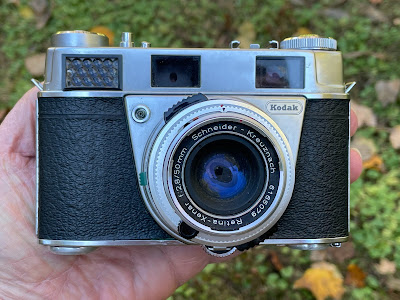
The Kodak Retina IIIS was the first of the rigid body rangefinder Retinas. In 1958 the list price for a Retina IIIS with an f/1.9 50mm lens was $193. The list price for a camera with an f/2.8 50mm lens was $158. Add a zero to the prices to get the equivalent in depreciated 2021 dollars. The same lenses fit the Retina Reflex S and later single lens reflex Retinas. About 45,000 Retina IIIS cameras were made.

Retina IIIS with an f/2.8 50mm Retina-Xenar lens


The front of the camera had the selenium cell exposure meter, the rangefinder window, the viewfinder window, the PC sync socket for flash, and the lens mount. The lens mount had the aperture setting wheel, the lens release button, the flash sync-self timer setting lever, the shutter speed ring and the aperture indicator ring. Lenses were interchangeable. The focusing ring was on the lens. The top of the camera had the film rewind knob and film type reminder, the accessory shoe, the exposure counter and its release button, the shutter buttton and the exposure meter dial. The back of the camera had the combined viewfinder-rangefinder eyepiece and the exposure counter setting button. The bottom of the camera had the tripod socket, the latch for the camera back, the rewind clutch button and the film advance lever. Advancing the film cocked the shutter. The camera back was hinged on the left.

f/4 135mm Retina-Tele-Xenar


f/4 85mm Retina-Tele-Arton

f/4 35mm Retina-Curtagon

f/4 28mm Retina-Curtagon lens and viewfinder

Lenses were made by Schneider and included a Retina-Curtagon f/4 28mm, a Retina-Curtagon f/2.8 35mm, a Retina-Xenar f/2.8 50mm, a Retina-Xenon f/1.9 50mm, a Retina-Tele-Arton f/4 85mm and a Retina-Tele-Xenar f/4 135mm. Prices for these lenses ranged from $75 to $88 in 1958. The viewfinder had permanent frame lines for the 35mm lens. Mounting a 50mm, 80mm or 135mm lens selected matching frame lines. The 28mm lens had too wide a field of view for the built in viewfinder, and took an auxiliary viewfinder that slipped into the accessory shoe.


The lenses used the Deckel bayonet mount. The Kodak Retina Reflex S and later Kodak Retina single lens reflex cameras used the same lens mount, except some Retina SLR camera lenses would not couple to the rangefinder. Edixa Electronica and Voigtlander Bessamatic SLRs used similar lens mounts. The leaf shutter was in the camera body behind the lens. Lenses had the focusing ring, the aperture diaphragm and moving depth of field indicators. The aperture was set using a small wheel on the bottom of the lens mount and was transmitted to the iris diaphragm in the lens by a lever. You would set the shutter speed, then turn the aperture setting wheel to set the aperture Once set, the aperture was coupled to the shutter speed; changing the shutter speed would also adjust the aperture to keep the exposure constant. The ring that displayed the aperture was on the lens mount. The lenses had a front bayonet fitting for lens accessories. A cam on the lens sent the focal distance to the rangefinder by a pin in the lens mount. A collar around the pin sent the frame line selection to the viewfinder.

The shutter was a Synchro-Compur behind-the-lens leaf shutter, with speeds from 1 second to 1/500 second plus Bulb. A lever on the side of the shutter switched to X-sync for electronic flash, M-sync by flash bulbs, or V for the self timer. The shutter release was on the body and was threaded for a cable release. The film advance and shutter were interlocked to prevent accidental blank frames or double exposures. To make a multiple exposure the photographer would press and hold the rewind clutch burtton while advancing the film.

The light meter used a galvanometer powered by a selenium cell and did not need batteries. An index needle on the light meter was coupled to the shutter and aperture settings. Matching the index needle to the galvanometer needle by changing the shutter speed and aperture would set the exposure. Unlike the previous Retina IIIC, the photographer did not have to manually transfer the meter reading to the lens. The film speed was set by pressing a button on the top of the meter and turning the aperture wheel.

The film counter was manually set to the number of exposures on the film and counted down. The counter was set by pressing the film counter release and wiggling the setting button back and forth. Otherwise, loading the film was the same as most 35mm cameras.

To rewind the film the photographer pushed the rewind clutch button and turned the rewind knob. The rewind clutch button would speed while the film was being rewound and stopped spinning when the film leader came off the take-up spool.

The IIIS was a hefty camera, weighing nearly 2 pounds, and much larger than the original folding Retina of 23 years earlier.