Tuesday, November 23, 2021

Brownie Target Six-20

The Brownie Target Six-20 was the last of the classic box Brownies. It debuted in 1946 and was discontinued in 1952. The list price was $3.50 in 1946, which was equivalent in purchasing power to about $50 in today's depreciated dollars.


This Brownie has a simple meniscus lens with two aperture stops, the "lens" in front of the shutter being only a flat piece of glass that helped keep dirt out of the camera. The shutter is a rotary shutter with an instant and time setting. The shutter opens when the shutter lever is moved down and is cocked when the shutter lever moves back up. This is different from the old Brownie shutter, which has a flip-flop action that opened the shutter every time the lever was moved. The single action of the Target versions of the Brownie reduced the chance of making an accidental double exposure, although there still is no automatic double exposure prevention. The two brilliant viewfinders let you take pictures in either portrait or landscape orientation. You space the pictures on the film by looking through the little red window at numbers printed on the backing paper. The camera has a slide you can pull out for time exposures, but no tripod socket. You have to put the camera on a stable chair or table to make a time exposure. The normal exposure is about 1/25 to 1/50 of a second. The shutter is not synchronized for flash. If you want to take a flash picture you need to use the open flash method. You put the camera on time, open the shutter, set off the flash, and then close the shutter. If you wanted a flash synchronized Brownie you bought the more expensive Flash Brownie. As the name of the camera implied, it took 620 film. It made eight 2-1/4" x 3-1/4" pictures on a roll of film. The next model Brownie was the molded plastic Brownie Hawkeye, which was a very popular camera.

This one says "Brownie Target Six-20" (the post-WWII name) on the faceplate, but "Target Brownie Six-20" (the pre-WWII name) on the cone.


Monday, November 22, 2021

Kodak VR35 K14 Medalist (1986-1989)

The Kodak VR35 K14 Medalist was the top of a line of point-and-shoot 35 mm cameras that Eastman Kodak Company introduced in 1986 and discontinued in 1989. It was the first Kodak 35mm camera since the Kodak Motormatic 35R4 was discontinued in 1969. The list price was an expensive $240. In 1986 the cartridge loading Instamatic camera had pretty much run its course, Kodak was losing a patent fight with Polaroid over Kodamatic instant cameras, the Kodak Disc was a flop, and Advantix cameras were nearly 10 years away. A new camera was needed. The VR35s were made for Eastman Kodak Company by Chinon Industries, Nagano, Japan. Kodak had a close relationship with Chinon and bought the company in 2005. Chinon is now an independent firm again.


The K14 has a blocky plastic body with a flip up flash. The top of the camera has just the shutter button. The front of the camera has two "eyes" for the infra-red auto focus system, the switch and warning light for the self timer, a flash control switch and a door that flips up to uncover the lens and viewfinder. Opening the door turns on the camera. The electronic flash is attached to the door and is raised about 3 inches above the lens when the door is open. The extra distance helps to reduce red eye. The back of the camera has the film data window, the date back, a green LED that flashes when the film advances, and the exposure counter. The bottom has the door for the battery compartment, the rewind switch, and a tripod socket. The camera strap clips onto the left side. The latch for the camera back is between the strap lugs.

The lens is a four element, f/2.8 35 mm Kodak Ektar lens. One of the lens elements is an aspherical lens made by Eastman in Rochester, NY. Close focus is 3 feet. An icon in the viewfinder glows red when the camera is in focus or flashes when the subject is too close. The viewfinder shows a head and shoulders icon for closeups, two persons for groups and mountains for scenes.

The shutter is electronically timed from 1/8 to 1/500 second. Holding the shutter button half way locks the focus. Holding the shutter button all the way in will take pictures continuously at the rate of one picture every two seconds. Exposure is programmed auto exposure. There isn't any exposure compensation setting. Film speed is set to 100, 200, 400 or 1000 by the DX code on the film cassette and defaults to 100 if the cassette isn't DX coded. The flash fires automatically in low light, although it can be switched off, and can be switched on for fill flash in daylight. This is a camera in the tradition of the first Kodak, "You press the button and we do the rest."

The camera takes a now-discontinued size 323L, 9V lithium battery. In a pinch, the battery compartment has extra contacts for a 9V transistor radio battery and a sticker to show the right way to it put in, but the transistor radio battery will run down fairly quickly. The date back takes a 3V lithium battery. The date back battery door is difficult to open and you frequently see cameras with broken door latches. The date back has three modes: month/day/year, time of day, and off. The year setting only goes from '85 to '09, which isn't much use for the year 2021. Did the camera come out a year late in 1986? Who knows.

The VR in the name comes from the VR technology used in Kodak color negative film, which improved sharpness and resolution. Kodak used the Medalist name for several different products, including a medium format camera and a disc format camera.

Tuesday, November 16, 2021

Kodak Retina IIIS (1958-61)

The Kodak Retina IIIS was the first of the rigid body rangefinder Retinas. In 1958 the list price for a Retina IIIS with an f/1.9 50mm lens was $193. The list price for a camera with an f/2.8 50mm lens was $158. Add a zero to the prices to get the equivalent in depreciated 2021 dollars. The same lenses fit the Retina Reflex S and later single lens reflex Retinas. About 45,000 Retina IIIS cameras were made.
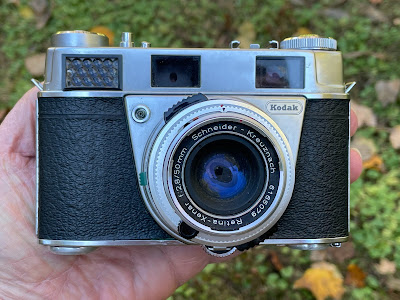
Retina IIIS with an f/2.8 50mm Retina-Xenar lens


The front of the camera had the selenium cell exposure meter, the rangefinder window, the viewfinder window, the PC sync socket for flash, and the lens mount. The lens mount had the aperture setting wheel, the lens release button, the flash sync-self timer setting lever, the shutter speed ring and the aperture indicator ring. Lenses were interchangeable. The focusing ring was on the lens. The top of the camera had the film rewind knob and film type reminder, the accessory shoe, the exposure counter and its release button, the shutter buttton and the exposure meter dial. The back of the camera had the combined viewfinder-rangefinder eyepiece and the exposure counter setting button. The bottom of the camera had the tripod socket, the latch for the camera back, the rewind clutch button and the film advance lever. Advancing the film cocked the shutter. The camera back was hinged on the left.

f/4 135mm Retina-Tele-Xenar


f/4 85mm Retina-Tele-Arton

f/4 35mm Retina-Curtagon

f/4 28mm Retina-Curtagon lens and viewfinder

Lenses were made by Schneider and included a Retina-Curtagon f/4 28mm, a Retina-Curtagon f/2.8 35mm, a Retina-Xenar f/2.8 50mm, a Retina-Xenon f/1.9 50mm, a Retina-Tele-Arton f/4 85mm and a Retina-Tele-Xenar f/4 135mm. Prices for these lenses ranged from $75 to $88 in 1958. The viewfinder had permanent frame lines for the 35mm lens. Mounting a 50mm, 80mm or 135mm lens selected matching frame lines. The 28mm lens had too wide a field of view for the built in viewfinder, and took an auxiliary viewfinder that slipped into the accessory shoe.


The lenses used the Deckel bayonet mount. The Kodak Retina Reflex S and later Kodak Retina single lens reflex cameras used the same lens mount, except some Retina SLR camera lenses would not couple to the rangefinder. Edixa Electronica and Voigtlander Bessamatic SLRs used similar lens mounts. The leaf shutter was in the camera body behind the lens. Lenses had the focusing ring, the aperture diaphragm and moving depth of field indicators. The aperture was set using a small wheel on the bottom of the lens mount and was transmitted to the iris diaphragm in the lens by a lever. You would set the shutter speed, then turn the aperture setting wheel to set the aperture Once set, the aperture was coupled to the shutter speed; changing the shutter speed would also adjust the aperture to keep the exposure constant. The ring that displayed the aperture was on the lens mount. The lenses had a front bayonet fitting for lens accessories. A cam on the lens sent the focal distance to the rangefinder by a pin in the lens mount. A collar around the pin sent the frame line selection to the viewfinder.

The shutter was a Synchro-Compur behind-the-lens leaf shutter, with speeds from 1 second to 1/500 second plus Bulb. A lever on the side of the shutter switched to X-sync for electronic flash, M-sync by flash bulbs, or V for the self timer. The shutter release was on the body and was threaded for a cable release. The film advance and shutter were interlocked to prevent accidental blank frames or double exposures. To make a multiple exposure the photographer would press and hold the rewind clutch burtton while advancing the film.

The light meter used a galvanometer powered by a selenium cell and did not need batteries. An index needle on the light meter was coupled to the shutter and aperture settings. Matching the index needle to the galvanometer needle by changing the shutter speed and aperture would set the exposure. Unlike the previous Retina IIIC, the photographer did not have to manually transfer the meter reading to the lens. The film speed was set by pressing a button on the top of the meter and turning the aperture wheel.

The film counter was manually set to the number of exposures on the film and counted down. The counter was set by pressing the film counter release and wiggling the setting button back and forth. Otherwise, loading the film was the same as most 35mm cameras.

To rewind the film the photographer pushed the rewind clutch button and turned the rewind knob. The rewind clutch button would speed while the film was being rewound and stopped spinning when the film leader came off the take-up spool.

The IIIS was a hefty camera, weighing nearly 2 pounds, and much larger than the original folding Retina of 23 years earlier.

Sunday, November 14, 2021

Bell & Howell TDC Stereo Vivid (1954-1960)

The Stereo Vivid is a Realist, or 5P, format stereo slide camera that was sold by Three Dimension Company, a subsidiary of Bell & Howell Co., Chicago, Illinois. The Vivid was made for TDC by Stereocraft Engineering Co., Portland, Oregon. Stereocraft became part of Sawyer's, the maker of View-Master products, in 1956. Sawyer's in turn became part of GAF in 1965.


The Stereo Vivid has an aluminum body with black leatherette. The top of the camera has the rewind knob, the flash contact, the aperture setting wheel, the shutter speed setting wheel, the exposure calculator, the film advance knob, and the focusing knob. The front of the camera has the viewfinder and range finder windows, the lenses, the shutter button and the cable release connection. There is a spirit level at the bottom of the range finder window. The bottom of the camera has a tripod socket and the instructions for loading film. The back of the camera has the combined viewfinder and range finder eyepiece. The camera back is hinged on the left. The latch button for the camera back is on the right.

The lenses are matched f/3.5-f/16 35 mm, coated Tridar anastigmats with three elements in three groups. The shutters are guillotine type located behind the lenses. Shutter speeds run from 1/10 to 1/100 second plus bulb. The shutter speed dial is marked at 1/10, 1/15, 1/25, 1/50 and 1/100 but can be set at intermediate speeds. A red triangle on the shutter speed dial indicates 1/35 second for synchronization with flashbulbs. The aperture dial can be set to any aperture from f/3.5 to f/16. Setting the aperture changes the depth of field markers under the transparent focusing knob. The focusing knob has a distance scale from 2-3/4 ft. (for use with the depth of field scale - the closest focus setting is 4 ft.) to infinity. The camera focuses by shifting the film plane.

The exposure calculator, called the "Expo Sure" system by TDC, is ingenious. In daylight the exposure dial is set by putting the ASA film speed against either the Summer or Winter index. You turn the shutter speed and aperture dials until the type of available light is against the mark for the type of subject, setting the correct exposure. Indoors using flash bulbs you turn the shutter speed dial until the red triangle is against the shutter speed index and turn the aperture dial until the distance to the subject is against the index for the type of flashbulb you are using. Because the camera was designed to use the slow color slide films available in the 1950s, the film speed settings go from 5 to only 100. The camera will take modern 50 or 100 speed slide film. The View-Master Personal Stereo camera, also made by Stereocraft, used a similar exposure calculator.

The camera has a coupled range finder. A spirit level is visible at the bottom of the range finder patch. The spirit level aids leveling the camera to create the stereo effect. The viewfinder is above the left taking lens so you need to take parallax into account when your subject is closer than about 5 feet. The Stereo Realist and the Kodak Stereo Camera centered the viewfinder between the taking lenses to avoid parallax error when framing a picture of a close subject.

The Vivid makes stereo slides in the Stereo Realist format, which was the most popular stereo format. You get 28 23 mm x 21 mm stereo pairs on a roll of 35 mm film made for 36 24 x 36 mm slides. The film counter counts down to show the number of pictures left on the roll. The film path is convoluted, passing under the sprocket wheels and over the rollers, which makes loading the film a little more complex than average. Fortunately, the film loading instructions are printed on the bottom of the camera.

One thing that is different about this camera is that the rewind knob free-wheels when it is pushed all the way in.  This is a little confusing if you are used to watching the rewind knob spin around to verify that the film is advancing properly.  To rewind the film you need to pull the knob half way up.  To remove the film cassette you need to pull the knob all the way up.

The Vivid uses a proprietary flasholder that screws to the top of the camera and uses bayonet base flashbulbs. There is a currently available electronic flash adapter for using a hot shoe flash.

The original list price for the Stereo Vivid in 1954 was $150, reduced to $130 in 1956. This was not a cheap camera at the time. About 30,000 were made. The rounded body of the Vivid is easier on the hand than the sharp-edged Stereo Realist. I think this is one of the nicer stereo cameras.

Stereo Film Strip

The image with the bump on top is the right hand image of each pair.

Saturday, November 13, 2021

Bolsey B3 (about 1956)

The Bolsey B3 is a Bolsey Jubilee without the "Set-o-matic" exposure calculator.  It was made about the time Bolsey Corp. of America was in financial difficulties and camera distribution was taken over by Obex. 


The camera has a die cast aluminum body with gray leatherette and chrome trim. The lens is a coated, f/2.8-f/22, 45 mm Bolsey-Steinheil Anastigmat with three elements in three groups. The shutter is a self-setting Bolsey-Gauthier leaf shutter with speeds running from 1/10 to 1/200 second plus B. The shutter is interlocked with the film advance to prevent double exposures. The camera needs to be loaded with film in order to operate the shutter. The shutter release is on the body of the camera. The back of the camera comes off for loading film. The film counter needs to be manually set to the number of pictures on the film and counts down. The film path is short enough to permit a couple of extra exposures on a regular roll of 35 mm film. There is a connection for a proprietary Bolsey flasholder.

Friday, November 12, 2021

Kodak Duex (1940-1942)


The Kodak Duex is a simple snapshot camera for sixteen 1-5/8" wide x 2-1/4" tall negatives on a roll of 620 film. The list price in 1940 was $5.75, which had the buying power of about $100 in 2020's depreciated dollars. The Duex has rounded ends like the 35 mm Kodak 35 cameras and resembles the popular minicam style roll film cameras that used 127 film.

Front

Top - Lens Retracted

Top - Lens Extended

Back

Left

Right

Bottom
The body is plastic with metal trim. The lens is a retractable Kodak Doublet and screws out to a fixed position for picture taking. The aperture is about f/11 and the focal length is about 3 inches. The lens will take a No. 13 close-up lens or a 1" Series V filter adapter. Ordinary snapshots are in focus from about 5 ft. to infinity. Pictures with the close-up lens are in focus at about 3-1/2 ft. The shutter is a rotary shutter with an "instant" setting for about 1/25 to 1/50 of a second and a "bulb" setting for as long as the shutter release is held open. The shutter will not fire with the lens retracted. The bottom has the tripod socket and the latch for the camera back. The back comes off for loading film. 120 film re-spooled on either old metal 620 spools or new plastic FPP 620 spools will work in this camera. Use ISO 100 or slower film outdoors in daylight.

Kodak also made a Duo 620 camera at its factory in Stuttgart, Germany, before the Second World War. The Duo 620 was a completely different camera, although it took the same size picture.


Memorial to World War I Dead, Centennial Park, Nashville, Tennessee This picture was taken November, 2021, using Ektar 100 film.