Thursday, March 7, 2019

A Small Herd of Ponies

The Kodak Pony 35mm cameras were on the market from 1950 to 1962. They are about the simplest possible adjustable cameras for 35mm film. These cameras have molded plastic bodies with removable backs for loading film. The finders are the reverse galilean type. A reverse galilean viewfinder has a negative lens at the front and a positive lens at the back to produce an image that is bright and correctly oriented, but reduced in size. All of the Pony cameras are scale-focusers. The Pony II, lower left, has a single speed shutter. The others have 4-speed shutters. Lenses are f/4.5 to f/3.5. All of the cameras are synchronized for flash. List prices were in the $30 range. Eastman Kodak Company had the inkjet printer business model for its inexpensive consumer cameras. Kodak made its money on the film, not on the camera. The Pony was the least expensive Kodak that could make a Kodachrome color slide.

Back row: Pony 135, Pony 135 model B, Pony 135 model C
Front row: Pony II, Pony IV with flash

Kodak Pony 135
Introduced: 1950
Discontinued: 1954
Lens: Kodak Anaston f/4.5-22 51mm in a collapsing lens mount.
Shutter: Kodak Flash 200 (1/25, 1/50, 1/100 and 1/200 plus bulb)
Flash connection: ASA bayonet

Kodak Pony 135 model B
Introduced: 1953
Discontinued: 1955
Lens: Kodak Anaston f/4.5-22 44mm in a collapsing lens mount.
Shutter: Kodak Flash 200
Flash connection: ASA bayonet

Kodak Pony 135 model C
Introduced: 1955
Discontinued: 1958
Lens: Kodak Anaston f/3.5-22 44mm in a rigid lens mount.
Shutter: Kodak Flash 300 (1/25, 1/50, 1/100 and 1/300 plus bulb)
Flash connection: ASA bayonet

Kodak Pony II
Introduced: 1957
Discontinued: 1962
Lens: Kodak Anastar f/3.9-22 44mm in a rigid lens mount. The aperture ring is marked only in EV numbers.
Shutter: Single speed flash (about 1/60)
Flash connection: Kodalite pin and screw

Kodak Pony IV
Introduced: 1957
Discontinued: 1961
Lens: Kodak Anastar f/3.5-22 44mm in a rigid lens mount. The aperture ring is marked in EV numbers on the top and f/stops on the bottom.
Shutter: Kodak Flash 250 (1/30, 1/60, 1/125, 1/250 plus bulb). The shutter speed ring is marked in EV numbers on the top and fractions of a second on the bottom. Add the aperture EV to the shutter EV to get the exposure value. The Argus Match-Matic that came out in 1958 uses the same method for setting the exposure.
Flash connection: Kodalite pin and screw.

The Pony IV has a retaining ring for  Series V drop-in filters built in. The other Pony cameras use a slip-on 1-1/8 inch (28.5mm) Series V filter adapter.

The exposure value (EV) is equal to the base 2 logarithm of the square of the focal ratio times the reciprocal of the shutter speed. A focal ratio of 16 and a shutter speed of 1/125 (log2(16 x 16 x 125)) gives an EV of 15.

The Ponies, with the exception of the Pony II, are still reasonably usable. I think the single speed shutter of the Pony II is just a little too limiting. Because the shutter and aperture settings on a Pony IV are interconnected, you need to remember to set the shutter speed first. If you set the aperture first, setting the shutter speed will change the aperture.

There was a 1949 Kodak Pony 828 that took Bantam 828 film, which had eight 28mm x 40mm pictures on a 35mm wide roll. It closely resembled the first Pony 135. The Pony 828 was discontinued in 1958.


Tuesday, March 5, 2019

Eastman Kodak Tri-X FIlm

2019 is the 65th anniversary of the release in 35 mm size of Tri-X film, probably the most popular black and white film ever made. 

A Box of Tri-X

If you saw a black and white news photograph the chances are it was taken on Tri-X. Tri-X sheet film had first appeared in the Kodak catalog in 1940. The name Tri-X most likely came from the fact that the film followed Super-XX film, which was Kodak's previous high speed roll film. Tri-X was changed in 1960 to have a shorter development time of only 8 minutes in D-76 developer instead of 12 minutes, and the film was changed again in 2007 to have slightly finer grain and the development time reduced to 6-3/4 minutes. Tri-X is well known for its versatility. It can be pushed from its normal 400 speed to 3200 speed and still yield good pictures in poor light. Pushing film means increasing the development time to compensate for less exposure than normal. The result is a printable negative, but with increased contrast and grain.

[Update] 2019 also is the 85th anniversary of the daylight loading 35mm film cartridge. Before 1934 still cameras that took 35mm film used proprietary cassettes and photographers would reload their own cassettes. Dr. August Nagel, who ran the Kodak-Nagel camera factory in Stuttgart, Germany, designed a disposable film cartridge and also a camera to use it, the Kodak Retina. Dr. Nagel had both the German and the US patents for the daylight loading magazine (as Kodak used to call it). Eastman Kodak had the manufacturing expertise to make daylight loading magazines by the million. The Kodak film magazine also fit Leica and Zeiss cameras.  35mm in daylight loading cartridges is the most popular film size now available, although sales of all sizes of film are much smaller than they once were.

Monday, February 25, 2019

Argus A2B (1939-1942 and 1946-1950)

The Argus A2B is an Argus A with an extinction exposure meter built in. This example is the post-WWII version that was made in Ann Arbor, Michigan, from 1946 to 1950. The pre-war version had an uncoated lens in a slightly different shutter. The viewfinder is a reverse galilean type. The lens is a coated Argus Anastigmat f/4.5-18 50 mm triplet. The lens collapses into the camera body and is zone focusing. You turn the lens barrel until it unlatches and extends for distant shots and turn it more until it pops out a little farther for close shots. In the unmarked close focus position the camera is focused for 8 ft. to 16 ft. In the unmarked distant focus position the camera is focused for 16 ft. to infinity. Instead of aperture settings from f/4.5 being marked in the normal sequence of 5.6, 8, 11 and 16, the f-stops are marked 6.3, 9, 12.7 and 18, which are sequential one-stop steps from 4.5 and one-third of a stop slower than the standard sequence. The shutter is a self-setting leaf shutter with speeds of 1/25, 1/50, 1/100 and 1/150 second plus bulb and time. The back comes off for loading film. The film runs from right to left, which was typical for Argus, but opposite most other cameras. After the film is loaded you manually set exposure counter to zero by turning the dial in the direction of the arrow. It counts up from zero when the film is advanced. To advance the film you push a catch on the top of the camera, turn the film winding knob a quarter turn, let go of the catch, and continue to wind the film until it stops. You press the shutter release on the side of the lens to take a picture. Pressing the shutter release cocks the shutter and releases the shutter in one motion.

Front

Back

The exposure meter has a strip of graduated filter material. To use the exposure meter the photographer holds the camera at arm's length and points it at the scene, then takes a quick look at the meter to see the darkest spot that still shows a little light. By setting the calculator for the film speed, general light conditions and the light visible in the meter, the photographer can calculate the shutter speed and aperture setting almost as accurately as by simply guessing. The film speeds are Weston exposure index numbers instead of ASA numbers. The Weston numbers were determined by film tests made by the Weston Electrical Instrument Company, who manufactured photoelectric exposure meters, and were about 80% of the corresponding ASA film speed. For example, a film with an ASA speed of 100 had a Weston speed of 80.

The post war version of the A2B was outdated when it appeared, but it was inexpensive, it worked and it was available.

[Update] Here is an example of the pre-war A2B (1939-1942). The trim and shutter are slightly different from the post-war version and the lens is uncoated. The shutter release is a plunger that can be unscrewed for a cable release. The plunger often is lost. Argus had a special cable release for the A2B because a standard cable release with a narrow pin can get hung in the shutter mechanism and damage it. The Argus cable release had a wide plunger that would not damage the shutter. The shutter speeds on the pre-war version were marked 1/25, 1/50, 1/100 and 1/200 plus B and T. The exposure calculator had matching shutter speeds.

Pre-war A2B

Pre-war A2B

[Update] The pre-war A2B was missing the film advance catch, which I've replaced with one from an Argus A that had a bad shutter.

Tuesday, February 19, 2019

Argus 40 (1950-1954)

The Argus 40 was made by Argus Cameras, Inc., Ann Arbor, Michigan, from 1950 to 1954. According to the date of manufacture printed on the inside of the camera, this example was made in April, 1953. The 40 came in several minor variations. The first ones did not have a name on the front (and were known as the "Model Argoflex"), some were marked "Argoflex" with no number, and the last ones were marked "Argus 40."

Front

Right

Back

Left

Top

With Flash

The viewfinder is a waist level brilliant viewfinder. A brilliant viewfinder consists of two positive lenses and a diagonal mirror. The image in the viewfinder is right side up, but reversed left to right. It is brighter than the image on a ground glass in a reflex viewfinder, but it does not show whether the camera is in focus. The taking lens is a coated Argus Varex f/4.5-22 75mm Anastigmat triplet lens with front cell focusing. The lens looks like the ones on the E, EM and EF. This is a scale focusing camera. The photographer estimated or measured the distance to the subject and set the distance on the lens. If the photographer set the distance to 25 ft. and the aperture to f/8 (both marked in red), the depth of field is great enough for subjects beyond 12 ft. to be in focus. The shutter is a self setting leaf shutter with speeds of 1/25, 1/50, 1/100 and 1/150 second plus bulb. As reminders, the 100 setting is marked red for black and white film on sunny days and the 25 is green for flash. The camera has a tripod socket on the bottom and provision for a cable release on the shutter. The shutter is synchronized for flash bulbs. After the shutter button is pressed the film has to be advanced before the button can be pressed again, to prevent accidental double exposures. The photographer can make a deliberate double exposure (or try again with the same picture if the flash failed to fire) by moving a small lever next to the shutter button. The Argus 76 flasholder plugs into the left side of the camera. The pins on the Argoflex 40 do not match the pins on the C3; therefore, a photographer can not use the same flasholder for both cameras. The camera takes 12 pictures on a roll of 620 film and has the familiar little red window on the back. The photographer spaces the pictures on the film by looking through the window at the picture numbers printed on the backing paper. The list price in 1950 was $33.95 (equivalent in purchasing power to $360 in 2019).

The 40 was followed by the simplified Argus Super Seventy-Five, which had a focusing lens, three selectable apertures and a single shutter speed (https://fourelementsinthreegroups.blogspot.com/2019/09/argus-super-seventy-five-1954-1958.html).

Monday, February 18, 2019

The Argus C Series (1938-1966)

Left-Right: Argus C, C2 and C3

Left-Right: Argus C, C2 and C3

Argus C2 (Left) and C3 (Right)

International Radio Corp. had created a best-seller in 1936 when it brought out the Argus A camera and two years later followed up with what developed into one of the longest selling 35 mm cameras.

The 1938 Argus C was a bakelite and metal "brick" with a 50mm f/3.5 three element lens, a behind-the-lens leaf shutter, and a built-in range finder.  Designed by the Belgian-American designer Gustave Fassin, it bore a slight resemblance to the Zeiss Ikon Contax, which had an all-black, squared-off body of similar dimensions.  The lens on the Argus C was a classic Cooke Triplet design in a helical focusing mount and could focus as close as three feet.  The lens was not removable.  The shutter was a set-and-release leaf shutter located behind the lens, and had speeds from 1/5 to 1/300 second.

The film advance and rewind was the same as on the Argus A series.  The film moved from right to left.  To advance the film you pressed the film advance catch, turned the film advance knob about a quarter turn, released the film advance catch, and wound the knob until it stopped.  To rewind the film you just turned the film rewind knob until the film was back inside the cassette.  The hinged back has a latch like the one on the model A. 

Shortly after the C came out, Argus produced the improved C2 model.  A gear was added to couple the range finder to the lens.

In 1939 the Argus C3 added a synchronized flash attachment and there things stood for the next 27 years.  Some cosmetic and mechanical changes were made over the years, but fundamentally the Argus C3 remained the same.  The post-war cameras did have coated lenses and the f/stops were changed from the continental system (f/18, f/12.7,  f/9, f/6.3, f/4.5, f/3.5) to the domestic system (f/16, f/11, f/8, f/5.6, f/4, f/3.5).  About 2 million C3s were sold.

Argus C advertisement in Popular Photography, April, 1938


Wednesday, February 13, 2019

Argus C33 (1959-1961)

The Argus C33 was introduced by Argus in 1959 and discontinued in 1961. You could buy one from Sears for ninety dollars, which in 1959 had the purchasing power of 780 of 2019's depreciated dollars. It was introduced only a year after the C44R, which had similar features but in my opinion was a better looking design. The boxy shape was similar to the venerable C3, which had been introduced in 1939 but outlasted the C33 by five years.  The mechanics were like the following Argus Autronic auto-exposure cameras.

Front

Top

Back

Bottom

Left

Right

Film Chamber

The C33 came with a coated Argus Cintar f/2.8-f/22 50mm lens, made by Argus in the USA, and could use an f/4.5-f/22 35mm lens or an f/4.5-f/22 100mm lens, both made by Steinheil in West Germany. The top of the camera had an accessory shoe for the Argus Zoom Viewfinder to use with the 35mm and 100mm lenses. The shutter speeds were 1/300, 1/125, 1/60, 1/30, 1/15, 1/8, 1/4, 1/2 and 1 second plus bulb. The matching Argus flasholder plugged into the left side of the camera, using the same socket as on the C3. An Argus CM-2 light meter attached to the shutter speed knob. The light meter was settable for film speeds from ASA 2.5 to 1250 and was coupled to the shutter speed dial. The photographer would select a shutter speed, point the camera at the scene and set the lens to the f-stop indicated by the meter. This is a clunky camera to hold.  The C33 appeared on the market the same time as the Eastman Kodak Company's Kodak Signet 80.


Friday, February 8, 2019

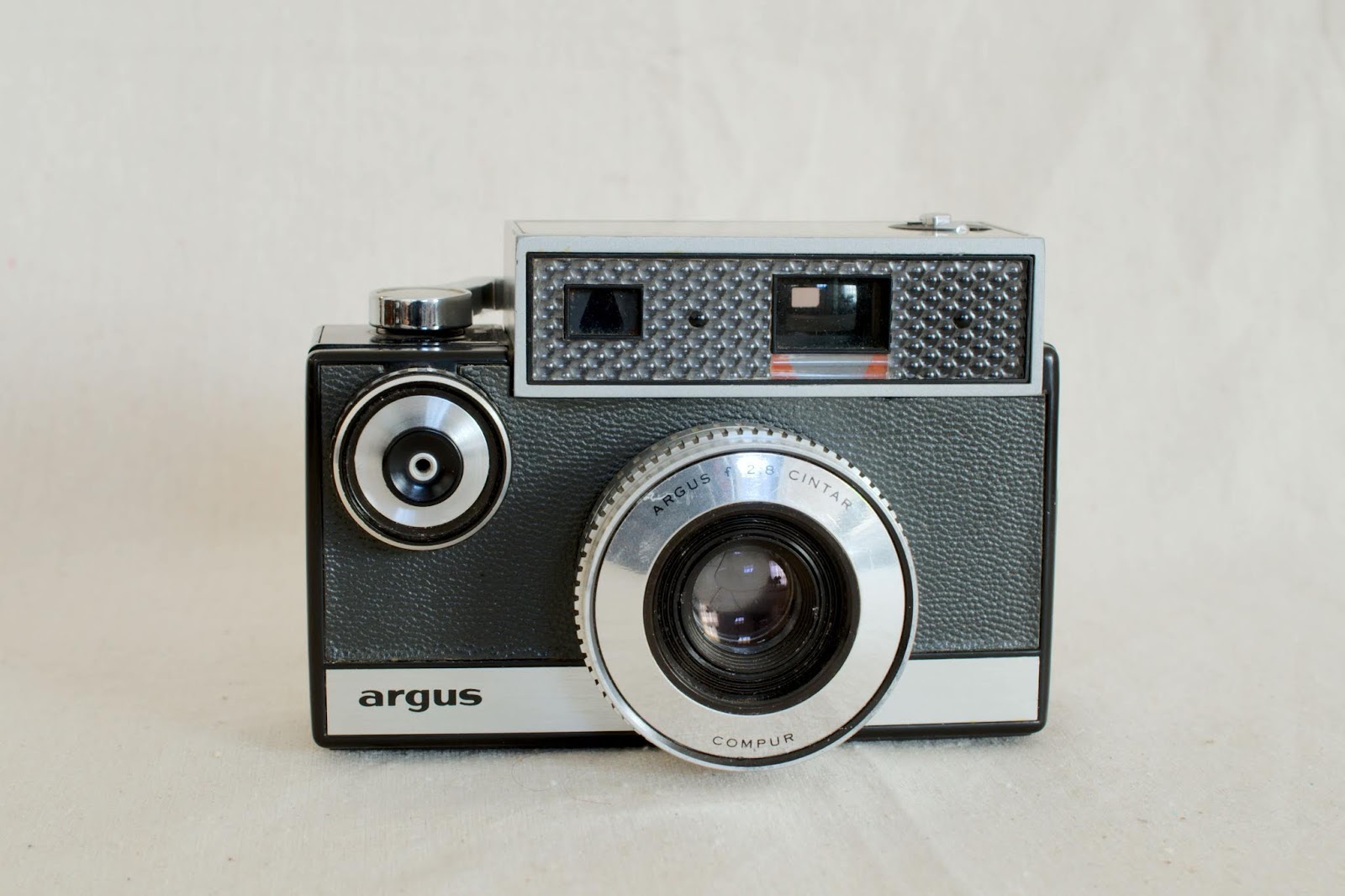
Argus Autronic I (1962-1965)

The Argus Autronic I was made by the Argus division of Sylvania Electric in the early '60s. It and the similar Autronic II were the last US made 35mm cameras to be introduced by Argus.

Front

Back

Top

Film Chamber

Shutter Speed and Aperture Settings

Film Speed Setting

Flash Exposure Setting Guide

Exposure automation in 35mm cameras began to be popular in the 1960s. "Electric eye" cameras used selenium cell light meters and electromechanical aperture diaphragms for shutter priority auto exposure. This camera has an f/2.8-f/22 50mm Argus Cintar lens in an imported German Compur shutter. The shutter speeds run from 1/500 second to 1/30 second plus bulb. The light meter can be set for ASA film speeds from 10 to 400. Film advance is by a single stroke lever. The back hinges down to open for loading film. The film counter should be manually set to the number of exposures on the roll, and counts down to zero. There is a rewind release lever on the bottom of the camera and a rewind crank on the top. The shape of the camera is reminiscent of the ever-popular C3 "Brick" and the mechanics are like the previous C33. The viewfinder has a coincident range finder with a triangular range finder patch. The camera focuses with a knob on the front surrounding the shutter release button. There is a threaded cable release socket in the shutter button. The matching flasholder plugs into the side of the camera. The camera is clunky and uncomfortable to hold.

Argus tried to eliminate any references to photographic esoterica like f-stops and shutter speeds. The lens barrel is marked with aperture numbers from 3 to 9 instead of f/2.8 to f/22. The shutter speed settings are marked "Flash", "Scene", "Action" and, in one concession to the photographic art, 500. The bulb setting for long exposures is not marked at all, but exists to the left of the "Flash" setting. The range finder knob is marked with flash setting numbers from 1 to 8 instead of feet. For flash photography the photographer was instructed to focus on the subject and then set the aperture to match the number on the range finder. The same method for setting flash exposure was used on the Match-Matic C3. The instruction book did give the shutter speed and f-stop equivalents to the camera markings for those who wanted to know.

The Autronics have a deserved reputation as unreliable cameras.  Argus stopped making the Autronics in 1965, and the venerable C3 in 1966. The Argus branded cameras that followed were all made overseas. By the time the Autronics came out Argus had already dipped its toe into the import ocean by importing the V-100 camera and lenses for a number of cameras from West Germany. Argus as a brand name gradually faded away and the last incarnation of Argus is long out of business.