Wednesday, January 29, 2020

Kodak Retina IIc (1955-1958)

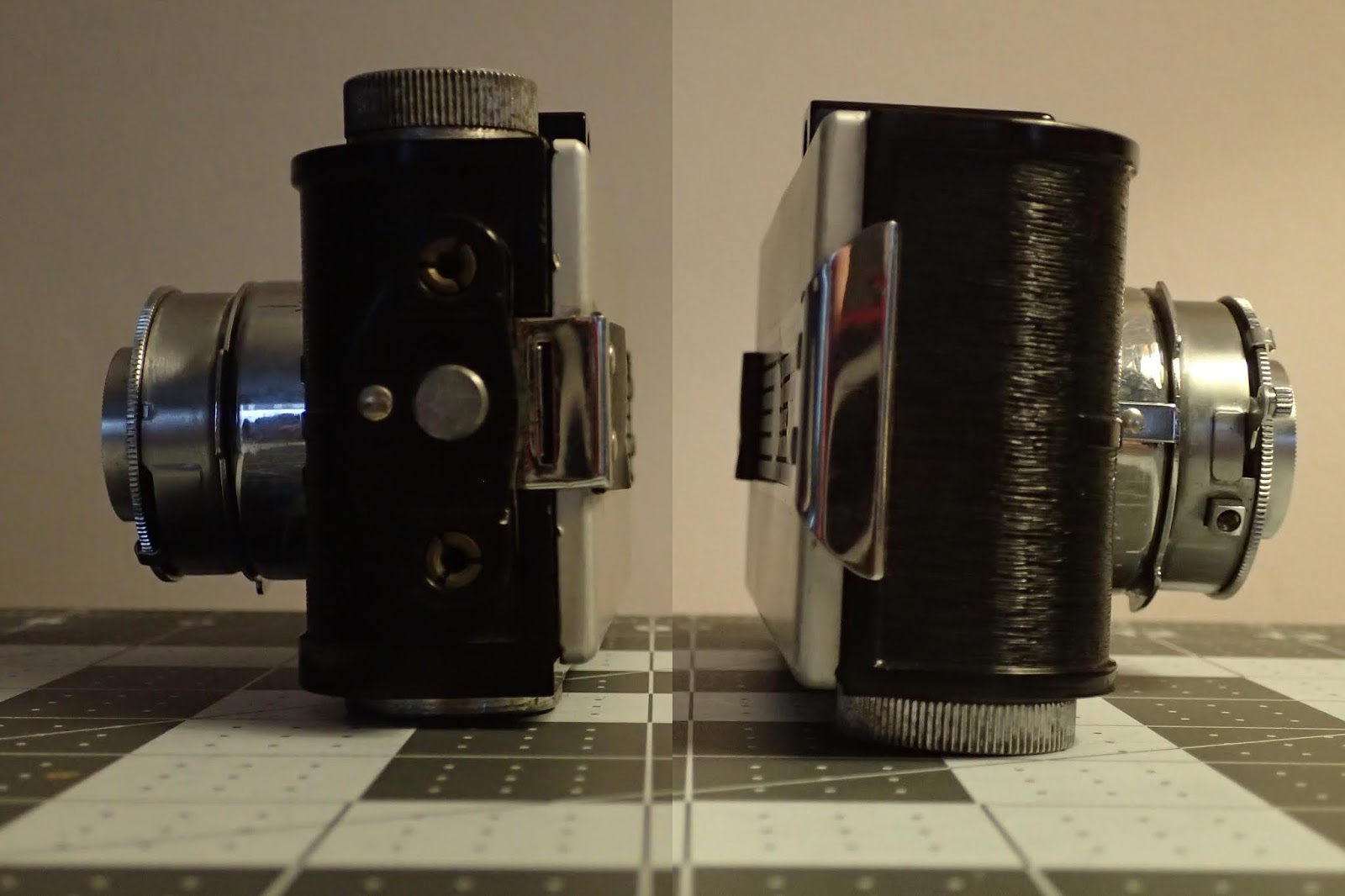
The Kodak Retina IIc is a convertible lens Retina that is functionally the same as the Retina IIIc (see the post for October 4, 2018), except for the lens (f/2.8 50mm instead of f/2 50mm) and the lack of a built-in light meter. The IIc did have an accessory shoe where you could attach a "Kodalux" light meter. A modern Sekonic L-208 Twinmate light meter fits just fine.  The IIc is barely smaller than the model IIIc that has a built-in light meter. 

Kodak Retina IIc

The front set of lens elements is replaceable to change the focal length from 50 mm, using the standard Schneider-Kreuznach Retina Xenon C set, to 35 mm, using the wide angle f/5.6 Retina Curtar Xenon C set, or 80 mm, using the telephoto f/4 Retina Longar Xenon C set (the post for October 30, 2018, shows a convertible lens on a Retina IIIc).

With the camera closed the lens is behind a door on the front of the camera. Pressing a button on side of the door lets it open to bring out the lens and shutter. To close the camera the photographer sets the focus to infinity (the camera won't close otherwise and forcing it can break the camera), presses two buttons on the top and bottom of the lens to unlatch the lens and close the lens door.

The latch for the film door is under a rotating cover on the bottom of the camera. To open the film door the photographer turns the cover and presses the revealed button. The rewind knob can pop up to allow the film cassette to be loaded. After loading the film the film counter needs to be set to the number of exposures on the film by pressing a button on the top of the camera and wiggling a button on the back of the camera. The film counter counts down to one and will not allow the film to be advanced after the last exposure is made. The film advance is a lever on the bottom of the camera. Advancing the film cocks the shutter. To rewind the film the photographer presses the clutch button on the back of the camera and turns the rewind knob until the film is back inside the cassette, when it is safe to take the film out of the camera.

Focusing is through a combined rangefinder-viewfinder window. The rangefinder patch is a bright diamond in the center of the viewfinder. The viewfinder also has frame lines for composing the picture. Earlier models of the Retina did not have frame lines.

The shutter is a rim set shutter and the aperture settings are coupled to the speed rim for using the exposure value system. The photographer would set the shutter speed, then set the aperture. A spring loaded latch would couple the aperture to the speed rim so that the aperture would follow the shutter speed. For example, 1/125 second at f/8 gives an exposure value of 14, and changing the shutter speed to a different value such as 1/500 would change the aperture to f/5.6, keeping the exposure the same.

The shutter is synchronized for flash using type M flashbulbs (M setting) or electronic flash (X setting). A self timer was available (V setting) that gave about a 10 second delay on releasing the shutter.

The list price in 1955 was $135, or about $1,300 in depreciated 2020 dollars. This was about a quarter the price of a Leica or Contax. Roughly 136,000 were made at Kodak's factory in Stuttgart, West Germany.

Friday, January 24, 2020

Argus FA (1950-1951)

Argus added a flash attachment to the A-series body to create the model FA. This was the last camera Argus made using the body style of the Argus A. It was followed by the A4 (see the post for September 16, 2019), which had a more modern appearance.

Argus FA

The back is striped instead of having the three rectangles of the other A body Arguses.


The flash attachment (left) takes the same flasholder as the Argus 75 or 40 twin lens cameras. The flasholder for the Argus C3 will not fit.

Instead of a serial number, a date (YYMM) was stamped inside the back. This one has March, 1951.

The FA has a coated f/4.5 Argus 50mm anastigmat in a self-setting shutter with speeds of 1/150, 1/100, 1/50 and 1/25 second plus B (bulb) and T (time). The 1/100 speed setting is red to indicate the shutter speed setting for an average daylight picture and the 1/25 setting is green to indicate the shutter speed setting for a flash picture. The aperture settings were marked f/4.5, f/5.6, f/8, f/11, f/16 and f/22. The 8 is red to indicate the aperture setting for an average daylight picture. The shutter has a cable release socket. The flash attachment takes the same flasholder as the Argus 40 or the Argus 75. The flasholder for the Argus C3 will not fit.

The Argus Model FA is the only A-body Argus where the zone focus settings are actually marked.

Left: 15 ft. to Infinity. Right: 6 ft. to 15 ft.

The list price in 1951 was $29.95 plus $4.08 for the flasholder and $5.50 for the case, the total of $39.53 being equivalent in purchasing power to $392 in depreciated 2019 dollars. The Argus FA apparently was not a commercial success, and stayed in the product line for only a couple of years.

The wire from the shutter to the flash contact is broken in this example. Since the flasholder is for flashbulbs only and flashbulbs aren't being made any more, I don't think I will try to replace the wire.

Thursday, January 23, 2020

Argus Argoflash model AA (1940-1942)

The Argus model AA added flash sync to the Argus A body. An Argus flasholder, the same as the one for the Argus C3, could plug into the sockets near the photographer's left hand. The lens was a fixed focus Argus f/6.3 Anastigmat Triplet in a ready-set, single speed shutter. The aperture settings are marked "f/6.3 - color - dull", "f/9 - cloudy" and "f/12.7 - sun - bright." "Color" in 1940 meant Kodachrome slide film, and Kodachrome needed two or three stops more exposure than the average black and white film. The lens and shutter look like the ones on the contemporary Argus model M camera that took size 828 (Kodak Bantam) film. Flash sync was an innovation at the time. Some high-end cameras such as the Leica III did not have built-in flash sync.

Argus AA


Wednesday, January 22, 2020

Argus B (1937)

The Argus model B is an Argus model A with an imported Prontor II shutter instead of an Ilex Precise shutter and a front cell focusing lens instead of a zone focusing lens. Only 1,000 were made. I think this might have just been a marketing test because the focusing model AF (see the post for June 27, 2018) came out at the same time and had a longer production run.


The camera body is molded from phenolic resin and the back is pressed aluminum. The film advance knob, reverse galilean viewfinder, film advance catch and exposure counter are on the top. The rewind knob is on the bottom. The lens and shutter are on a collapsible mount like the one on the model A, except that the B doesn't have two position zone focus on the mount. The uncoated lens is marked "Argus Anastigmat f/2.9 5 cm" and "Made in France." It is a front cell focuser. The shutter is a Prontor II made by Alfred Gauthier, Calmbach, Germany, and is marked with the AGC logo and "Made in Germany". It has speeds of 1/175, 1/100, 1/50, 1/25, 1/10, 1/5, 1/2 and 1 second plus B (bulb) and T (time), and it has a self timer, which was uncommon in 1937. The shutter is cocked by a lever near the top and the shutter release is on the photographer's right. The self timer is on the bottom of the shutter. The rest of the camera is just like a model A.


Saturday, January 11, 2020

Pre-WWII Kodak Retina II 142 (1937-1939)

This Kodak Retina II (142) was made in the Kodak AG - Dr Nagel Werk factory in Stuttgart-Wangen, Germany, a year or two before the start of the Second World War in Europe. The list price in the Kodak Stores' catalog for 1938 was $140, equivalent in buying power to about $2,500 in depreciated 2020 dollars.

Front

Right

Left

Top

Bottom

Back

Interior

The camera is a folding 35mm camera with chrome and black leather finish on a light alloy body. The range finder is coupled to the lens and has a separate eyepiece from the viewfinder. The lens is an uncoated f/2 50mm Schneider Kreuznach Retina-Xenon in a rim set Deckel Compur-Rapid shutter that runs from 1/500 second to 1 second plus bulb and is not synchronized for flash. The lens focuses as close as 3.5 ft. Advancing the film does not automatically cock the shutter. Before taking a picture the shutter needs to be cocked using the lever near the top of the shutter. The shutter release is on the body and is interlocked with the shutter and film advance to prevent double exposures or skipped frames. The aperture setting is by a lever near the bottom of the lens. The camera takes 35mm film in standard daylight loading magazines. The exposure counter needs to be reset manually after loading film and counts up from zero. A depth of field calculator and a tripod socket are located on the bottom of the camera.

The first Retina camera (See the post for October 30, 2018) was a scale focuser and was called simply the Retina. The subsequent scale focusing models were renamed Retina I when the rangefinder focusing Retina II came out. Kodak had a number of different cameras with the Retina II name. The initial Retina II (122) has a lever wind film advance. That model was not a success and was replaced by the Retina II (142) with a knob wind film advance. The number 142 Retina has a circle around the "II" to show that it is a different (and more reliable) model. The post-war Retina II is a different design with a combined viewfinder-rangefinder eyepiece. It is based on a pre-war Retina IIa that was not sold in the US.

One odd thing about the 142 Retina II is that the rangefinder eyepiece looks through an opening in the rewind shaft.  I guess this was done to widen the rangefinder baseline.  There is a catch that locks the rewind shaft with the opening in position for using the rangefinder.  To rewind the film you move the rewind/advance lever to "R" and hold the catch while rotating the rewind knob.  The take-up spool grips the film leader tightly and it takes some force to pull the leader off the take-up spool. If you try to rewind the film all the way into the cassette, the force needed to pull the film from the take-up spool can scratch the film. Instead of trying to rewind the film all the way into the cassette, it is a good idea to leave the leader out and unhook the film from the take-up spool after you open the camera back

Retinas were quality cameras in a class with the best cameras made in Germany. Although not cheap, they still were less expensive than a Leica or Contax, and they took good pictures. The US Kodak most like the Retina II was the Bantam Special (see the post for November 7, 2018).

Sunday, December 8, 2019

Graflex Century Graphic (1947-1970)

The Graflex Century Graphic is a miniature press camera that was made by Graflex Inc. in Rochester, New York, from 1947 to 1970. Press cameras were made to meet the needs of newspaper photographers and are of robust construction.

Front

Rear

The Century folds into a fairly compact package. The photographer presses a hidden button on the top of the camera to release the lens bed and opens it until it locked into place. He then draws out the lens standard until it hits the infinity stops on the rails and locks it into place. The camera has limited movements on the front: rise, shift and tilt, and the bed can be dropped. The drop bed and front rise are useful to get the front of the lens bed out of the picture with wide angle lenses. The shifts are available only with lenses that have focal lengths longer than normal because otherwise the front lens standard hits the lens bed struts.

The camera has an open frame viewfinder and could come with an optional optical viewfinder. Focusing is by ground glass with the camera on a tripod, by the focusing scale located on the lens bed or by an optional Kalart coupled range finder.

The Century could be customized with a variety of lenses and shutters. This example has an f/4.5 103mm Graflex Trioptar lens made by Wollensak in a Graflex Century shutter also made by Wollensak. This was the lowest price combination. Better lenses and shutters made by Eastman Kodak Company also were available, for example the f/4.5 101mm Kodak Ektar in a Kodak Flash Supermatic shutter. Other lenses by manufacturers such as Zeiss or Schneider, and shutters such as the Compur Rapid were imported from Germany. The size of the lens board and the length of the bellows draw limit the diameter and focal length of the lenses that can be used. The focusing scales on the lens bed need to be matched to the lens for scale focusing to work. The Kalart rangefinder also needs to be adjusted to match the lens. Ground glass focusing works with any lens without any further adjustments.

A Century Graphic came with a removable ground glass back for 2-1/4" x 3-1/4" sheet film in holders, two sheets to a holder, and had a Graflok back for the optional roll film holders. The "23" roll film holder is for eight 2-1/4" x 3-1/4" pictures on 120 film. A "22" roll film holder for twelve 2-1/4" square pictures on 120 film also was available. The roll film holders had dark slides, which allowed the film holders to be removed mid-roll without wasting a picture. If you don't want to handle individual sheets of film in a darkroom, a roll film holder is desirable.

You needed to have the camera on a tripod to use ground glass focusing. You opened the shutter, focused and composed the picture on the ground glass as in a view camera, closed the shutter, set the taking aperture and shutter speed, inserted the loaded sheet film holder, pulled out the dark slide on the sheet film holder, exposed the film, replaced the dark slide and took the exposed film to the darkroom in the holder. Hand-holding the camera, you would focus using the distance scale on the lens bed or the Kalart range finder and compose the picture using the open frame finder or the optical finder. Using the roll film holder is like using any other roll film camera. When you use the roll film holder it puts your eye a little farther from the optical finder than when you use  the ground glass back.

This camera attracts attention when out in public. Unfortunately the bellows on my 70 year old example has developed a light leak and it is out of commission right now. I have a replacement bellows and just need to get around to putting in the new one. The half-silvered glass beam splitter on the rangefinder has tarnished and the focusing patch is only faintly reflected. Deteriorated beam splitters are common.  Replacing the beam splitter is possible, but requires cutting a replacement to fit.

A gnarly tree in Centennial Park, Nashville, Tennessee, pre-light leak.

Advertisement, Popular Photography, April, 1950.

Tuesday, December 3, 2019

Kodak VR35 K12 (1986-1989)

Eastman Kodak Company stopped making 35 mm cameras in 1969 owing to the phenomenal success of the cartridge loading Instamatic cameras. The popularity of cartridge loading cameras gradually declined as compact point-and-shoot cameras with autofocus and automatic film loading became available.  Kodak re-introduced a new line of point-and-shoot 35 mm cameras in 1986 and discontinued the last of the Instamatic cameras in 1988. This camera was manufactured for Kodak by Chinon Industries. Kodak had a close relationship with Chinon and eventually bought the company in 2004.

Front - Closed

Front - Open

Back

The K12 has a plastic body with a flip up flash. The lens is a four element, f/2.8 35 mm Kodak Ektar lens with an aspherical lens element that was made by Eastman in Rochester, NY. The shutter is electronically timed from 1/8 to 1/500 second. The film is advanced automatically after each picture and rewinds automatically at the end of the roll. Flipping up the flash uncovers the lens and turns on the camera. Auto focusing is by an infrared sensor through two "eyes" next to the lens. Exposure is programmed auto exposure. Film speed is set to ASA 100, 200, 400 or 1000 by the DX code on the film cassette. Operation is almost completely automatic. This is a camera in the tradition of the first Kodak of 100 years earlier - "You press the button and we do the rest." The controls are the shutter button, a self-timer switch, a switch for fill flash in daylight, and a switch to rewind the film mid-roll. The flash fires automatically in low light. The camera takes a now-discontinued size 323, 9V lithium battery. A 9V transistor radio battery will power the camera, but runs down pretty quickly. The use of a transistor radio battery was anticipated by Kodak because the battery compartment has contacts for the transistor radio and a sticker to show the right way to put it in. The list price was an expensive $200 in 1986. It was discontinued in 1989. They are cheap today. The K12 was the second best of the VR35s. The top of the line K14 "Medalist" was similar, but had in addition a data back to imprint the date on the negative, and a switch to turn off the flash. The bottom of the line VR35 K2 had a hot shoe for flash, a fixed focus, fixed aperture lens, a single shutter speed, and manual film advance and rewind.

The VR35 name ties in with the Kodak VR-G film that came out about the same time. VR technology is still used in current Kodak film.